A unique royal boat from the 1st century has been found near Alexandria: Strabo's description has been confirmed.

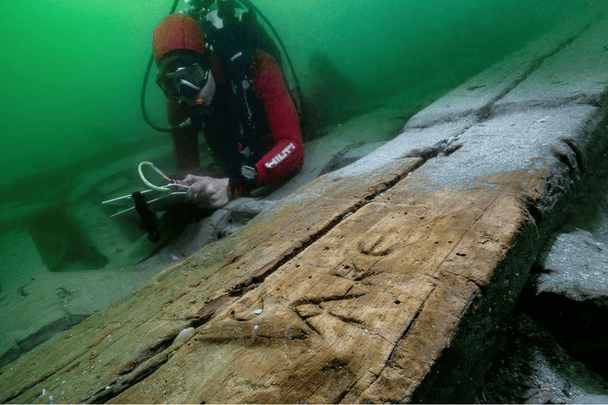
According to ТСН: Near Alexandria, archaeologists discovered an ancient Egyptian pleasure boat 35 meters long, mentioned by the Greek historian Strabo in the 1st century. This find dates back to the first half of the 1st century and has a luxuriously decorated cabin, indicating the boat's connection to the royal court.
Alexandria, marked by palaces, temples, and the 130-meter Pharos lighthouse, was one of the most lavish cities of antiquity. Archaeologists found the boat near the sunken remains of the island of Antirhodos, which was once part of the Great Port of Alexandria.
Strabo, who visited Egypt around 29 – 25 BC, described similar vessels as follows: 'These ships are luxuriously equipped and used by the royal court for excursions; and the crowd of revelers descends from Alexandria through the canal to public festivities; for each day and every night is filled with people on boats, endlessly playing the flute and dancing with excessive debauchery.'
The study was conducted by the European Institute of Underwater Archaeology led by Professor of Maritime Archaeology at the University of Oxford Frank Goddio.
'This is incredibly exciting because, for the first time in history, such a boat has been found in Egypt... These vessels were mentioned by various ancient authors, such as Strabo, and they are also depicted in iconography. However, a [real boat] had never been found before,' said Goddio.
Unlike the 15-meter boat depicted in the mosaic, this boat proved to be much larger. Preserved wooden elements indicate a width of about 7 meters, and there could have been more than 20 rowers to operate it. The vessel lay at a depth of only 7 meters underwater and under a 1.5-meter layer of sediment.
Initially, Goddio thought he saw two ships, as the design was quite unusual. He noted: 'The bow is flat, and the stern is rounded, so it can navigate in very shallow waters.'
The boat was found less than 50 meters from the Temple of Isis, which Goddio is currently investigating. He believes that the boat sank due to the devastating destruction of the temple around AD 50 from severe earthquakes and tsunamis that led to the flooding of Portus Magnus and part of the coastline.
There is also a hypothesis that the vessel could have been part of temple rituals.
'It could have been... part of the marine ceremony navigatio iside when a procession in honor of [the goddess] Isis meets an ornate vessel representing the solar barque of Isis, the mistress of the sea,' noted Goddio.
Greek graffiti have been found on the central beam, which still needs to be deciphered. Although research at this stage is ongoing, the ship, according to Goddio, will provide a new insight into 'the life, religion, luxury, and recreation along the waterways of early Roman Egypt.'
'This is a type of vessel that has never been found before. While we can read about such cabin boats in ancient texts and see them in artistic depictions, having an archaeological counterpart is astounding,' emphasized the center's director, Professor Damian Robinson.
The wreck of the vessel will be left on the seabed.
'We adhere to UNESCO rules, which prefer [to leave] the remains underwater,' clarified Goddio.
Only a small part of the area has been researched, and excavations will continue.
Additionally, in Egyptian Tanis, archaeologists found an untouched treasure in an ancient pharaonic tomb, which, however, turned out to be empty. The treasure contains 225 masterfully crafted funerary statuettes (ushabti), arranged in an unusual ritual order. The symbols on the figurines confirmed that the tomb was intended for Pharaoh Sheshonq III, whose burial place remained a mystery.
The discovery of the ancient Egyptian pleasure boat near Alexandria is an important archaeological event that opens new horizons for research on life and culture in ancient Egypt. Such finds add depth to our understanding of marine traditions and rituals of the era. The research continues, and new discoveries could significantly impact the study of the history of this ancient civilization.Read also
- Ukrainian Drones Stall Russian Army's Advance on Kupiansk Front: No Positions Lost
- IAEA Demands Iran Report on Uranium Stockpiles, Backed by U.S. and European Powers
- Germany’s Admiral Explains Why Ukraine Now Leads the World in Defense Innovation
- Ukraine Faces Record Night Attack: 221 Drones and Iskander Missiles Launched
- Zaporizhzhia and Sumy Under Russian Attack: Eight Wounded, Hundreds of Structures Damaged
- China Deploys HIMARS for the First Time Toward the Taiwan Strait: Exercise Breakdown