Geminids 2025: up to 150 meteors per hour and other astronomical events in December.

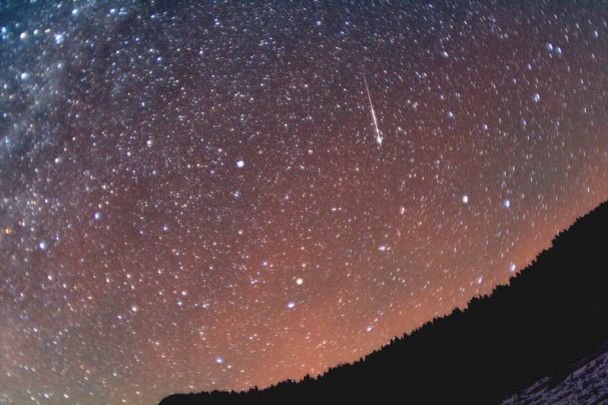
According to ТСН: December is a time of contrasts. On one hand, we encounter the longest and darkest nights of the year, while on the other, this darkness reveals to us the bright treasures of the Universe. The winter sky of 2025 promises an impressive program: from the 'dance' of the giant planets to a stunning meteor shower. To ensure you don't miss anything, we have prepared a detailed guide to the astronomical events of this month.
Farewell to the interstellar traveler
At the beginning of the month, pay attention to the comet 3I/ATLAS. Although its maximum approach to Earth is forecasted for December 19, there is no need to wait for this date. The comet is rapidly moving away from the Sun, losing brightness.
Currently, it is over 340 million kilometers away. So, if you have binoculars or a small telescope, try to locate this guest at the beginning of December. Later, it will become too dim for observation.
Supermoon and planet parade
On December 5, the sky will be illuminated by the full Moon, marking the end of this year’s series of supermoons. On this night, our satellite will appear slightly larger and brighter, creating the perfect atmosphere for winter walks, even while 'washing out' dim stars.
This won’t deter you from observing the planets:
Saturn showcases a rare view: its rings are tilted edgewise towards Earth and look like a thin band crossing the planet's disk. Look for it in the evenings in the constellation Aquarius.
Jupiter is the true king of December. Approaching its opposition, it looks large and bright. Its bands can be easily seen through a telescope.
Mercury has prepared a surprise for the early risers. December 7 is the best time for its observation. The swift planet will move to its maximum distance from the Sun and will be visible at dawn, low on the eastern horizon.
However, Venus and Mars are 'taking a vacation' in December and hiding in the rays of the Sun, so they will not be seen.
The main show of the month: the Geminid meteor shower
If you love making wishes on falling stars, then the night of December 13-14 is your starry time. It is during this time that the Geminid meteor shower will reach its peak.
This shower is one of the most powerful and beautiful 'meteor showers' of the year. Astronomers predict up to 150 meteors per hour! Geminids are characterized by slow (about 35 km/s) yellowish meteors that can flare very brightly (the so-called fireballs).
Why are the conditions favorable this year?
Last year, the Geminids coincided with a full Moon, whose light overshadowed the spectacle. This year, conditions are ideal: the Moon will be in its last quarter phase and will rise only after 3 AM. Therefore, you will have the first half of the night to enjoy a dark sky streaked with fiery trails.
How to observe:
Observation should be done on the night of December 14. The most active phase is from 02:00 to 04:00.
The radiant (the point where meteors originate) is located in the constellation Gemini, but it’s better to look a bit to the side, so the trails are longer.
Telescopes are not needed – just your eyes, warm clothing, a thermos with tea, and preferably a recliner for comfortable positioning.
Interesting fact: the parent of this shower is not a comet, as usual, but a strange asteroid Phaethon, which leaves behind a trail of dust.
Winter solstice: a turn towards spring
On December 21 at 17:04 Kyiv time, the moment of the winter solstice occurs. This is the astronomical beginning of winter.
On this day, the Sun will rise the lowest over the horizon throughout the year, and we will have the shortest day (in Kyiv, it will last just over 8 hours) and the longest night. However, the good news is that after this date, the daylight will start to gradually increase, the darkness will begin to recede, bringing us closer to spring.
Time for telescopes
The end of the month, especially December 20, when there will be a new Moon (the best time for star observation), will be ideal for observing distant cosmic objects. Without moonlight, the sky looks velvet.
This is the best time to search for the famous Orion Nebula. Even with binoculars, it appears as a fuzzy cloud, while through a telescope it reveals a complex structure – it is a 'nursery' for new stars. High in the sky, the star cluster Pleiades (Seven Sisters) in the constellation Taurus will shine like a scatter of diamonds.
So, even if the weather on the ground is gloomy, remember: cosmic magic happens above the clouds. You just have to wait for a clear window and look up.
Event calendar in brief:
December 5 – Supermoon (full moon).
December 7 – best morning visibility of Mercury.
December 14 – peak of the Geminid meteor shower (up to 150 'stars' per hour).
December 19 – minimum distance to comet 3I/ATLAS (telescope required).
December 20 – New Moon (best time for star observation).
December 21 – Winter solstice (the longest night of the year).
As a reminder, astronomers have announced an important milestone – the number of known near-Earth asteroids has officially reached 40,000. This list includes objects from several-meter fragments to multi-kilometer bodies that move in orbits capable of approaching Earth.
Read also
- Your Ultimate Guide to Choosing the Perfect Summer T-Shirt: Fabric and Neckline Tips
- Egg-Free Kefir Pancakes: A Simple Recipe with a Dough Secret
- White Acacia Kvass: A Step-by-Step Guide from Klopotenko
- A 30-Minute No-Bake Lemon Dessert: Easy Recipe with Everyday Ingredients
- Easy Pickled Tomatoes for Winter: The Perfect Brine Recipe Using 1 Liter of Water
- A 15-Minute Dinner That Feels Like a Feast: Carbonara-Style Potatoes with Bacon and Cream Sauce