An Ancient Home Bank Found in France: 40 Thousand Coins in Jugs.

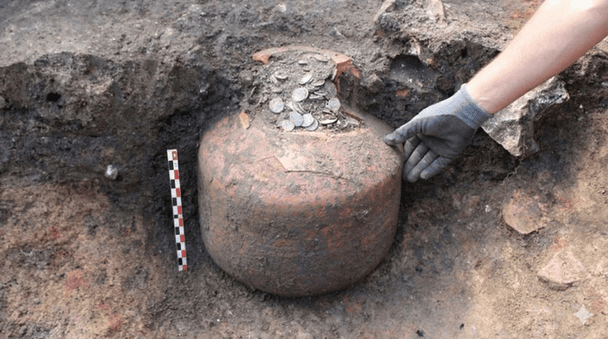
According to ТСН: In a small French village of Senon, archaeologists made an important discovery that will help understand the financial habits of people during the Roman Empire. During excavations of an ancient settlement, researchers from the National Institute for Preventive Archaeological Research (INRAP) stumbled upon three ceramic vessels, two of which were filled with tens of thousands of coins.
The weight of the find is almost 90 kilograms
The amounts of the found treasure are impressive. The first jug contained approximately 38 kilograms of coins, which corresponds to about 23-24 thousand units, according to numismatists.
The second jug, along with its contents, weighed about 50 kilograms and was less numerous – containing 18 to 19 thousand coins. The third jug was empty, as its contents had been taken long ago, leaving only a few coins at the bottom.
Thus, in total, the find may contain more than 40,000 coins dated between 280 and 310 AD. Among them are images of the emperors of the Gallic Empire, which existed separately from Rome for some time.
This was not a hiding place, but a 'safe'
Usually, treasures were buried in a hurry, fleeing from danger. But in this case, everything looks different. The amphorae were carefully placed in specially prepared pits on the floor of the living room, and their openings were at ground level, making them easily accessible.
Scientists believe this was a kind of 'home bank' or a safe for long-term savings.
'The presence of several coins stuck on the rim of the jug clearly indicates that they were placed there after the amphora was buried,' the archaeologists' report states.
Thus, the owners regularly replenished their stocks, using them as piggy banks.
Why the money remained in the ground
The house where the coins were found was wealthy – with stone walls and underfloor heating. However, the story of this 'bank' ended tragically. In the early 4th century, the settlement was destroyed by a major fire.
Presumably, it was the fire that forced the inhabitants to flee, leaving their savings, which lay underground for almost two millennia until modern researchers discovered them.
Let us recall that in an ancient Greek city on the Aegean coast, archaeologists found a small clay pot filled with Persian gold coins. This treasure, buried around 2400 years ago, may conceal a tragic secret.
This find in Senon emphasizes how important archaeological research is for understanding human history. It provides insight into the financial habits of ancient people and their daily lives. Research of this kind enriches knowledge of the past and inspires modern times for new discoveries and scholarly studies.
Read also
- Ukrainian Drones Stall Russian Army's Advance on Kupiansk Front: No Positions Lost
- IAEA Demands Iran Report on Uranium Stockpiles, Backed by U.S. and European Powers
- Germany’s Admiral Explains Why Ukraine Now Leads the World in Defense Innovation
- Ukraine Faces Record Night Attack: 221 Drones and Iskander Missiles Launched
- Zaporizhzhia and Sumy Under Russian Attack: Eight Wounded, Hundreds of Structures Damaged
- China Deploys HIMARS for the First Time Toward the Taiwan Strait: Exercise Breakdown