Lady Metelitsya: the true story of the goddess of winter and rebirth.

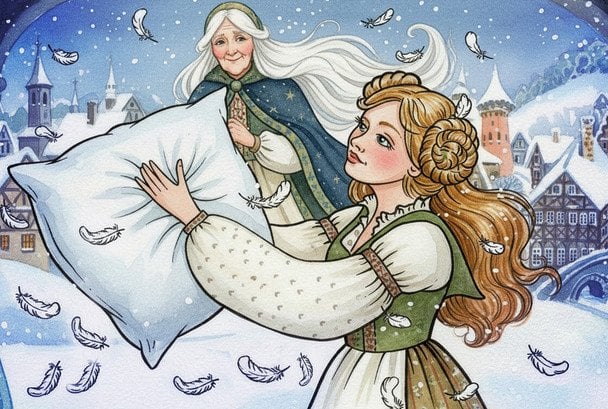
According to ТСН: In folk tales, Lady Metelitsya is often depicted as the protector of snow and blizzards. However, her image is much deeper and more complex. According to ancient European beliefs, she was not only the spirit of winter but also the mistress of the underworld, guarding transitions and the silence where new life is born.
In her underground realm, the seeds of the next harvest are kept, the spirits of nature rest, and the earth itself is rejuvenated. This is a place where all excess dies, and life is renewed. When she shakes her blankets, and snow falls to the ground, it means that the gates between worlds are covered by a blanket of silence. Nature enters a crucial stage of internal renewal.
Historical roots of the image
Maria Gimbutas, a renowned researcher of ancient European cultures, mentions Gould (Lady Metelitsya) — Holle, Holla — as an ancient Germanic goddess who predates most of the German pantheon. She existed long before the emergence of gods such as Odin, Thor, Freya, or Loki. In her research, Gimbutas emphasizes that Holle continues the traditions of the Proto-Indo-European goddesses of Neolithic Europe — great mothers, mistresses of life, death, and rebirth.
This indicates that Lady Metelitsya is not a random character of folklore, but a living shadow of a great archaic tradition that has survived centuries.
Transformation of images
When Christianity began to displace Scandinavian paganism, the images of old goddesses underwent changes. Instead of open worship, they began to be preserved in tales, rituals, and folk traditions. By the end of the High Middle Ages, Scandinavian cults became marginal, but the images of spirits, particularly Lady Metelitsya, continued to live in folklore.
In German pre-Christian folklore, the names Gould, Holle, and Holla reflected the same being in different regions, serving as the guardian of the boundary between worlds. Children who died as infants fell under her care, leading to names such as Großmutter (Dark Grandma) or Weisse Frau (White Lady). These names demonstrate her dual nature: she is simultaneously a light protector and a guardian of shadows.
Magic and significance
Her connection to the underworld and women's crafts — spinning and weaving — was associated with witchcraft in Christian tradition. However, in folk beliefs, this remained knowledge of fate and the ability to weave time.
Thus, Lady Metelitsya is not only snow and winter. She is the archetype of great feminine power, governing the cycles of life and death, guarding the underworld, and watching over the birth of new beginnings in silence.
And when the blizzard stirs outside, it is worth remembering: this is not just a natural phenomenon. It is the breath of the goddess who watches over the world and gives it time for rebirth.
In the context of modernity, the image of Lady Metelitsya can be perceived as a call to preserve natural cycles and respect for nature. She symbolizes not only winter but also a period of tranquility and renewal when nature prepares new lives for spring.
Read also
- Weekend Love Forecast: Which Chinese Zodiac Signs Will Shine on June 6–7
- Love in June 2026: These Three Chinese Zodiac Signs—Tiger, Goat, and Dog—Are Set to Find Romance
- Four Must-Watch Love Stories Recommended by Netflix
- Romance Hits Five Zodiac Signs in Late May: See Who Made the List
- Lenormand Cards for April 2: A Day of Clarity and Problem-Solving
- Uncertainty and Clarity in April: What to Expect for Your Career and Relationships