A 4500-Year-Old Temple-Observatory of the God Ra Discovered in Egypt.

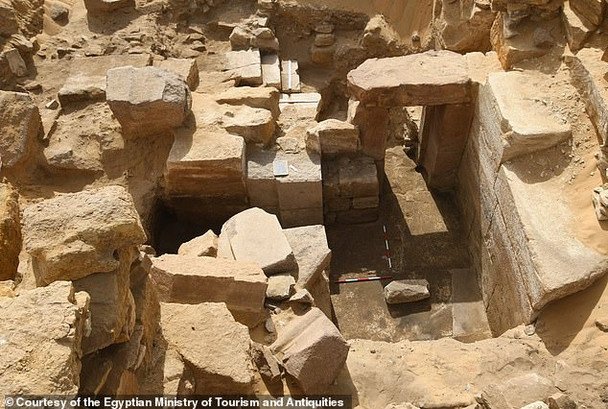
According to ТСН: In Abu-Ghurab (Egypt), archaeologists uncovered the remnants of a massive temple dedicated to the sun god Ra, which had lain beneath the Nile's sediments for over 4500 years. This structure, covering an area of 1000 square meters, served not only as a sanctuary but also as an ancient astronomical observatory.
Scientists made the discovery of the remains of the Egyptian temple, dating back approximately 4500 years. This temple, located about 14 kilometers south of Cairo, covered an area of more than 10,000 square feet (about 1000 sq. m) and was dedicated to Ra – the sun god and creator of all that exists.
The structure was built on the orders of Pharaoh Nyuserra Ini, who ruled approximately from 2420 to 2389 BC during the Fifth Dynasty of Ancient Egypt.
According to information from Egypt's Ministry of Tourism and Antiquities, the complex featured a stone-carved public calendar of religious events, as well as a roof used for astronomical observations.
Photos from the excavations showcase numerous well-preserved artifacts, including fragments of walls with hieroglyphic inscriptions and pieces of ceramic ware.
“Due to the unique architectural plan, this is one of the largest and most significant temples in the valley. Carved stone fragments of high-quality white limestone and a large quantity of ceramics were also found,”- stated the ministry.
The archaeological site has been known to scientists since 1901, when it was identified by German archaeologist Ludwig Borchardt, but a high groundwater level made thorough excavation impossible. The situation changed during a new wave of research that began in 2024, when archaeologists were able to reveal over half of the temple, which had long been covered by layers of silt.
As a result of the excavations, researchers identified the entrance part of the structure, including the original floor and remnants of a round granite column that was likely part of the entrance portico. Fragments of the original stone cladding of corridor walls, as well as other architectural details such as granite tiles and door constructions, were also discovered.
The archaeological mission documented the remains of internal stairs leading to the roof in the northwest part of the temple, likely serving as an additional entrance, as well as a sloping passage that, according to suggestions, connected the temple with the Nile or its branches.
“The temple's roof in the valley was likely used for astronomical observations, but not for festive ceremonies,”- explained archaeologist and co-director of the excavations Massimiliano Nuzzolo.
It was also noted that the lower level of the structure was used as a dock for boats from the Nile or possibly from one of its side canals. Among the expedition's finds is a unique collection of items, including two wooden pieces from the board game 'Senet,' popular in Ancient Egypt and often compared to modern chess.
“Thus, the sanctuary gradually turned into a dwelling, and one of the locals' favorite pastimes was likely playing 'Senet',- Nuzzolo noted.
Preliminary research results indicate that after completing its cult function, the temple gradually became a small residential settlement for locals. Further archaeological work may provide a clearer picture of the history of the complex before it was finally covered by Nile silt.
The mission is preparing to continue its work in the coming seasons to explore new elements of this important archaeological site.
“The discovery of new details will significantly enhance our understanding of the origins and development of solar temples in Ancient Egypt,”- reported the ministry.
Additionally, archaeologists in the Egyptian Tanis made a sensational discovery, finding 225 ritual figurines in the empty tomb of Pharaoh Shoshenq III. This is the first such large-scale finding in 80 years, preserved untouched in its original ritual arrangement in the shape of a star.
The discoveries made during excavations in Abu-Ghurab not only testify to the ancient religious life of the Egyptians but also highlight their astronomical knowledge. The discovery of the temple emphasizes the importance of archaeological research in restoring the historical memory of a civilization that has influenced the development of world culture. Such findings help understand how ancient societies interacted with nature and what beliefs they held in their daily lives.Read also
- IAEA Demands Iran Report on Uranium Stockpiles, Backed by U.S. and European Powers
- Germany’s Admiral Explains Why Ukraine Now Leads the World in Defense Innovation
- Ukraine Faces Record Night Attack: 221 Drones and Iskander Missiles Launched
- Zaporizhzhia and Sumy Under Russian Attack: Eight Wounded, Hundreds of Structures Damaged
- China Deploys HIMARS for the First Time Toward the Taiwan Strait: Exercise Breakdown
- Overnight on June 11, Russia Launches 221 Drones and Two Missiles in Massive Assault on Ukraine