Zelensky and Trump agreed on security guarantees: why Putin will not stop the war.

According to ТСН: Ukrainian President Volodymyr Zelensky and US President Donald Trump completed a new stage of negotiations regarding a possible peaceful resolution of the conflict between Russia and Ukraine. The parties noted significant progress, including almost complete coordination of security guarantees for Ukraine.
However, the most complex issues remain unresolved. According to Donald Trump, Vladimir Putin does not agree to a ceasefire.
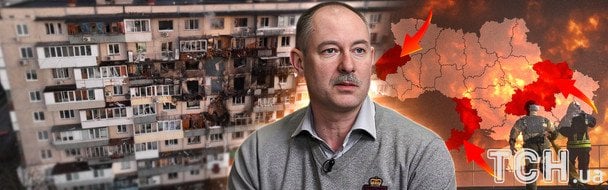
Military expert Oleg Zhdanov commented on the developments of the situation with shelling and explained why Russia is not interested in ending hostilities.
Why Putin does not want peace
Oleg Zhdanov notes that Russian dictator Putin is not striving for an end to the war, and this can be easily explained. He believes that no new events on the battlefield should be expected in the near future.
“Putin is confident that they are advancing on all fronts, he is being told this, and we see it in the broadcasts of federal channels of the Russian Federation... Putin said, why should we stop now if by the end of spring we will have 'liberated' everything — that is, captured the Donetsk and Luhansk regions in full. Therefore, it is impossible for Putin to stop now. You know, one can get into war, but it is very difficult to get out of war. You understand how complicated the mechanism for a ceasefire is. For the order to reach a particular soldier in the trench, and this soldier must execute this order, and not open fire and not start shooting. So, in this sense, it is impossible for Putin to stop today,” says Oleg Zhdanov.
How the war will change in the near future
According to Zhdanov, the war will not change in the near future — Putin will continue massive strikes on Ukraine and at the front:
“Look, even now, it would seem, there are certain problems with personnel, with equipment — still, the Russian Federation is pulling everything from training centers. The number of combat clashes ranges from 150 to 260 per day. One day they gather personnel to put them into action, and then for a day they madly storm our positions. By the way, partisans say that in Berdyansk they are pulling out everything they can pull out. Everyone who was hiding in the rear, in training centers, is now being brought to the front.”
How Putin disrupts negotiations and manipulates conditions
Zhdanov emphasizes that the Kremlin uses the topic of negotiations to buy time, changing rhetoric and the conditions for a possible truce.
“Sometimes he wants an operational pause, sometimes he is ready to agree, and then he does not want to. Sometimes he is ready to agree to a ceasefire during voting, initially it was a one-day vote for the presidential elections, then he changed his mind. Now he initially agreed for a 60-day referendum, and then he changed his mind. This, in my opinion, is just a game... Trump is his subordinate,” says Oleg Zhdanov.
According to him, Trump is completely dependent on Putin. He emphasizes that Putin is buying time, trying to save face in the eyes of the world community, proving that he is not the aggressor.
Zhdanov expresses doubts about the real security guarantees that, according to President Zelensky, have allegedly been agreed upon:
“Well, they agreed to negotiate. And even those security guarantees that President Zelensky said were supposedly 100% agreed. With whom? Good question. With Trump? And who will implement these security guarantees? The US Congress. First of all, there is still no bill at all. And what is the opinion of congressmen regarding the adoption of this law? So is it agreed or not? This is nonsense, this is a piece of paper, just opinions on paper, this can be said. Because the US Congress, two chambers, Senate and House of Representatives — there are five hundred people. Try to get it passed. And Congress is not for capitalizing Ukraine, but for the majority, as surveys show, including among congressmen, they are for providing us with weapons and supporting Ukraine.”
When is a ceasefire realistically possible
The only reason that could force an end to hostilities is a change of power in Russia, the military expert believes.
“If something happens in the power offices on Red Square, in the Kremlin, then one could count on some kind of change. But for now, I see that even the so-called 'Peace Party', as Dmitriev - Ushakov calls it, they do not have levers of influence on Putin. Still, Lavrov goes out and states that everything remains, that Ukraine must accept all the conditions of the Russian Federation.”
'Window of Opportunity' and Budanov's Statement
Oleg Zhdanov believes that the words of the head of the Main Intelligence Directorate of Ukraine, Kyrylo Budanov, about a 'window of opportunity' for a peace agreement in February 2026 do not correspond to the realities of the war:
“What kind of window of opportunity does he see? I have just painted a real picture, look at the front line.”
Russia will exert as much pressure as possible
Zhdanov emphasizes that the main goal of Russia's massive strikes on Ukraine is pressure on the civilian population.
“There is one goal. It has remained as it was. This is pressure on society, shaping public opinion. If our state does not want to engage in this, our enemy is doing it.
Thus, the situation at the front remains tense, and the peace process so far has not yielded results. Experts note that the key problem remains the Kremlin's position, which determines further actions and strategies for both sides. It is important to continue to monitor the developments, as this will affect not only Ukrainian but also international interests in the region.
Read also
- Armenia’s Parliamentary Elections Begin: What Impact on Regional Politics?
- Ukraine’s Role and New Troop Deployments in Europe: Andrew Michta on Why NATO Must Strengthen Now
- Biden Labels Trump the Most Corrupt President in U.S. History
- Nearly 2.5 Million Eligible Voters Head to the Polls as Armenia’s Parliamentary Elections Begin
- Armenia Votes: Pashinyan's Future Hangs in the Balance Amid Strained Ties with Russia
- US-Iran Talks Hit an Impasse Over Tehran’s $24 Billion Demand