The Mystery of the Holes Strip in Peru Revealed: It Was an Ancient Goods Accounting System.

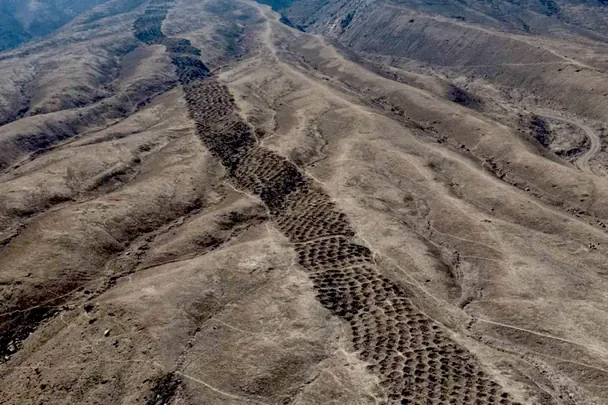
According to ТСН: In the Peruvian Pisco Valley, archaeologists have presented new research on one of the most mysterious objects of the Andes — a strip with approximately 5200 holes carved into the slope of Monte Siérpe. This structure, known as the 'Holes Strip', has remained unexplained for decades.
Scientists used drones for detailed mapping and discovered a clear organization of the holes: they are arranged in blocks, divided into sections, and repeat the same numerical patterns. As noted by the lead author of the study, digital archaeologist Jacob Bongers, such a format may indicate a functional purpose of the object rather than random or purely decorative origins.
Structure and Discovered Cultural Remains
Monte Siérpe consists of shallow pits ranging from 1 to 2 meters wide and up to 1 meter deep. Although the strip appears solid from a distance, it is actually distributed by passages that allow movement along the slope. Soil analysis revealed corn pollen as well as traces of reeds, pumpkins, amaranth, cotton, and chili peppers. These plants do not grow in the arid area where the object is located, indicating their intentional introduction by humans.
Functionality and History of the Object
Researchers believe the holes might have been used for storing goods, and they view Monte Siérpe as part of an indigenous system of exchange and accounting. They also note the analogy of this structure with the Inca quipu — a knot system for recording quantities and resources, but outline this as a hypothesis.
Radiocarbon analysis indicates that the object was actively used in the 14th century, during a period when the region was ruled by the Chinchay Kingdom. Historical sources indicate that the Chinchas were developed traders who controlled exchange networks along the coast and inland until the arrival of the Incas. Monte Siérpe is located near pre-Hispanic routes connecting various ecological zones.
Scientists emphasize that the holes were not storage facilities in the modern sense. They believe that these elements could have functioned as visual markers of quantity, allowing for an assessment of the volume of goods without the need for money. Later, during the Inca Empire, such infrastructure might have been reinterpreted for state accounting needs.
'The Holes Strip' has been known to science since 1933 — it was then noticed in aerial photographs published in National Geographic. Since then, various versions of its purpose have been proposed — from a defensive structure to a water collection system. The new study does not provide a definitive answer, however, according to the authors, it offers the most convincing arguments to date regarding the origin of Monte Siérpe.
This finding indicates a complex socio-economic structure of ancient civilizations in Peru, which were able to organize the exchange and storage of resources over a large area. Understanding the functions of this object may shed light on the ways of trade and accounting in antiquity, as well as on the connections between different cultures in the region.
Read also
- IAEA Demands Iran Report on Uranium Stockpiles, Backed by U.S. and European Powers
- Germany’s Admiral Explains Why Ukraine Now Leads the World in Defense Innovation
- Ukraine Faces Record Night Attack: 221 Drones and Iskander Missiles Launched
- Zaporizhzhia and Sumy Under Russian Attack: Eight Wounded, Hundreds of Structures Damaged
- China Deploys HIMARS for the First Time Toward the Taiwan Strait: Exercise Breakdown
- Overnight on June 11, Russia Launches 221 Drones and Two Missiles in Massive Assault on Ukraine