The Tomb of Qin Shi Huang has not been opened for over 2200 years: what is kept a secret.

According to ТСН: The tomb of the first emperor of China, Qin Shi Huang, has remained closed for more than 2200 years, despite modern technological advances. Researchers are concerned not only about legendary traps but also about real toxic mercury lakes.
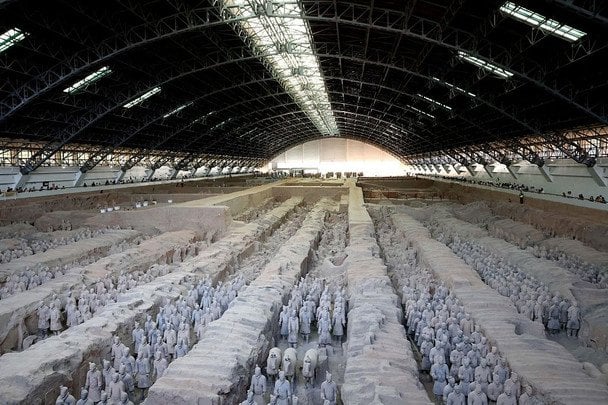
In 1974, farmers in Shaanxi province accidentally discovered an object that changed archaeologists' views of the past. Initially, it was simple clay fragments, but eventually it turned out to be the famous archaeological discovery - the Terracotta Army.
After the excavations were completed, humanity first gained access to approximately 8000 unique statues after 2200 years. But it turned out that this is only part of a larger mystery.
The Terracotta Army is just a fragment of a vast and mysterious burial complex associated with Emperor Qin Shi Huang. Little is known about the tomb itself, but it is likely part of a huge complex that has been closed since 208 BC.
Archaeologists have not yet conducted deep research here and probably will not do so in the near future.
The Tomb of Qin Shi Huang - a city underground
The complex, known as the Mausoleum of Qin Shi Huang, is located in modern Xi'an, Shaanxi province. It is known that it took about 38 years to build, with work completed around 208 BC.
Researchers believe the structure of the complex may have mirrored the layout of Xi'an, the capital of the Qin dynasty. According to UNESCO, the total area of the mausoleum is approximately 56.25 square kilometers.
Ancient Chinese historians, including Sima Qian, described the tomb as an underground palace with 'mercury rivers' flowing through special channels. About 700,000 workers were involved in building the complex, but modern researchers estimate the actual number at around 16,000.
Sima Qian also writes about a decorated ceiling symbolizing the starry sky, and protective mechanisms to deter robbers. Although it is not precisely known how accurate these descriptions are, modern research confirms some of them.
Geophysical analyses have shown a high level of mercury around the mound, suggesting its possible presence inside. Radar studies have revealed large cavities and structures that hint at the existence of multi-level rooms. But why are the excavations not continuing?
A step into the unknown
The reasons lie in political factors and preservation issues. Although legends about traps and mercury rivers can be frightening, they are not the main obstacle to excavation.
Archaeologists have studied parts of the outer mausoleum - workshops, burial pits, and the Terracotta Army, but the central mound with the tomb remains untouched. It is designed to be preserved in its original state forever, likely being airtight.
Any attempt to breach this isolation could lead to catastrophic changes in temperature and humidity, threatening the destruction of its contents. This has already been confirmed in practice during the excavations of the Terracotta Army, where the paint from statues started to flake off after contact with air.
That is why the State Administration of Cultural Heritage of China adheres to the principle: excavations are only possible with a guarantee of complete preservation. Currently, modern technology does not allow achieving this.
Two threats: mercury and politics
In addition to preservation issues, there are risks of a physical and political nature. Mercury vapors already pose an environmental threat on the surface. If there are mercury lakes inside, their discovery could lead to poisoning.
Specialists in hazardous materials are needed to organize such an expedition, making it incredibly complex.
Politically, Qin Shi Huang is a significant figure in Chinese history, and his tomb is a national symbol. Poor excavations or damage to artifacts would cause widespread resonance. The expectation of technology also gives the government the opportunity to minimize risks.
China generally maintains a cautious approach in archaeology, especially in cases with strong political and symbolic weight.
Look but do not touch
Although there are restrictions, there is also good news. Scientists can obtain information about the tomb without direct intervention. For years, non-invasive studies have been conducted, including ground-penetrating radar scanning and magnetometric methods.
Such studies allow archaeologists to reconstruct the internal space of the complex without breaching its airtightness. The tomb is one of the most thoroughly studied yet unopened structures in the world. Thanks to this, science can 'touch' its internal space without coming into direct contact.
By the way, in eastern China, paleontologists found unique dinosaur eggs whose cavities were filled with calcite crystals, allowing them to describe a new species - Shixingoolithus qianshanensis, possibly a relative of herbivorous ornithopods. Clutches with rare dinosaur embryos that preserved skeletal details have also been discovered.
Thus, the tomb of Qin Shi Huang remains one of the greatest mysteries of archaeology. And although excavations may be blocked for a long time, modern technology allows scientists to gradually uncover the mysteries of this unique complex. Only time will tell what the giant mound hides beneath the ground.
Read also
- Ukrainian Drones Stall Russian Army's Advance on Kupiansk Front: No Positions Lost
- IAEA Demands Iran Report on Uranium Stockpiles, Backed by U.S. and European Powers
- Germany’s Admiral Explains Why Ukraine Now Leads the World in Defense Innovation
- Ukraine Faces Record Night Attack: 221 Drones and Iskander Missiles Launched
- Zaporizhzhia and Sumy Under Russian Attack: Eight Wounded, Hundreds of Structures Damaged
- China Deploys HIMARS for the First Time Toward the Taiwan Strait: Exercise Breakdown