Mars Influences Earth's Ice Ages: Scientists' Discoveries.

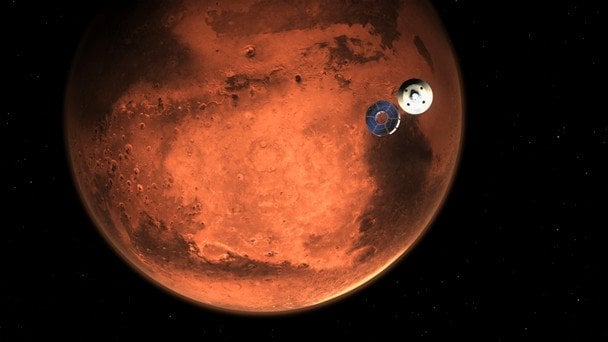
According to ТСН: Scientists have determined that Mars has a significant, albeit previously unaccounted for, impact on Earth's climate. Recent research shows that the gravity of the Red Planet interferes with the formation of climate cycles that regulate the alternation of glacial and warmer periods over millions of years.
Earth's climate changes according to Milankovitch cycles, which are linked to long-term fluctuations in orbit, axial tilt, and pole shifts. This happens due to the gravitational influence of other planets in the Solar System, which gradually alters Earth's movement around the Sun.
Previously, the primary focus in these cycles was on Jupiter and Venus. However, a new detailed study revealed that, despite its smaller mass, Mars also plays an important role. A team led by astronomer Stephen Kane conducted a series of computer simulations, varying Mars's mass from zero to ten times its actual value. These models allowed for observing how changes in mass affect Earth's orbital parameters over millions of years.
The Influence of Mars on Climate Cycles
The results showed that the main element of the climate system is a 405,000-year cycle of Earth's orbital eccentricity, which remains constant regardless of Mars's mass. This cycle acts as a sort of 'metronome' of climate changes, driven by the interaction between Venus and Jupiter.
Shorter cycles lasting about 100,000 years proved to be highly dependent on Mars. In the simulations, as Mars's mass increased, these cycles became longer and more pronounced, indicating a strengthening of gravitational connections between the inner planets of the Solar System.
Long-Term Climate Fluctuations
Researchers also noted a 2.4-million-year 'huge cycle' that impacts long-term climate fluctuations. In models that did not take Mars into account, this cycle completely disappeared. Scientists concluded that it exists only due to Mars's sufficient mass, which creates the necessary gravitational resonance with Earth's orbit, thus affecting the amount of solar radiation Earth receives over geological epochs.
Mars's gravity also affects Earth's axial tilt. The well-known 41,000-year axial tilt cycle, as per geological data, prolongs with an increase in Mars's mass. In scenarios where Mars is ten times heavier, this cycle shifts to a dominating period within 45-55 thousand years, significantly altering the nature of the formation and retreat of ice sheets.
Researchers emphasize that these findings are important not only for understanding Earth's climatic history but also for assessing the potential for life on exoplanets. A rocky planet with a massive neighbor and the appropriate orbital configuration may experience climate fluctuations that prevent complete freezing and create more stable conditions for life.
It is also noteworthy that astronomers recently discovered a new planet outside the Solar System, which appeared 50 million years after the dinosaurs went extinct on Earth.
These discoveries add a new dimension to our understanding of climatic processes on Earth and around other planets. They confirm that the interaction between planets is crucial not only for our climate cycles but also for the search for life on exoplanets and open new horizons in astronomy and planetary science.
Read also
- IAEA Demands Iran Report on Uranium Stockpiles, Backed by U.S. and European Powers
- Germany’s Admiral Explains Why Ukraine Now Leads the World in Defense Innovation
- Ukraine Faces Record Night Attack: 221 Drones and Iskander Missiles Launched
- Zaporizhzhia and Sumy Under Russian Attack: Eight Wounded, Hundreds of Structures Damaged
- China Deploys HIMARS for the First Time Toward the Taiwan Strait: Exercise Breakdown
- Overnight on June 11, Russia Launches 221 Drones and Two Missiles in Massive Assault on Ukraine