Gravitational Signal Detected Near a Newly Formed Black Hole for the First Time.

Discovery of the GW250114 Signal
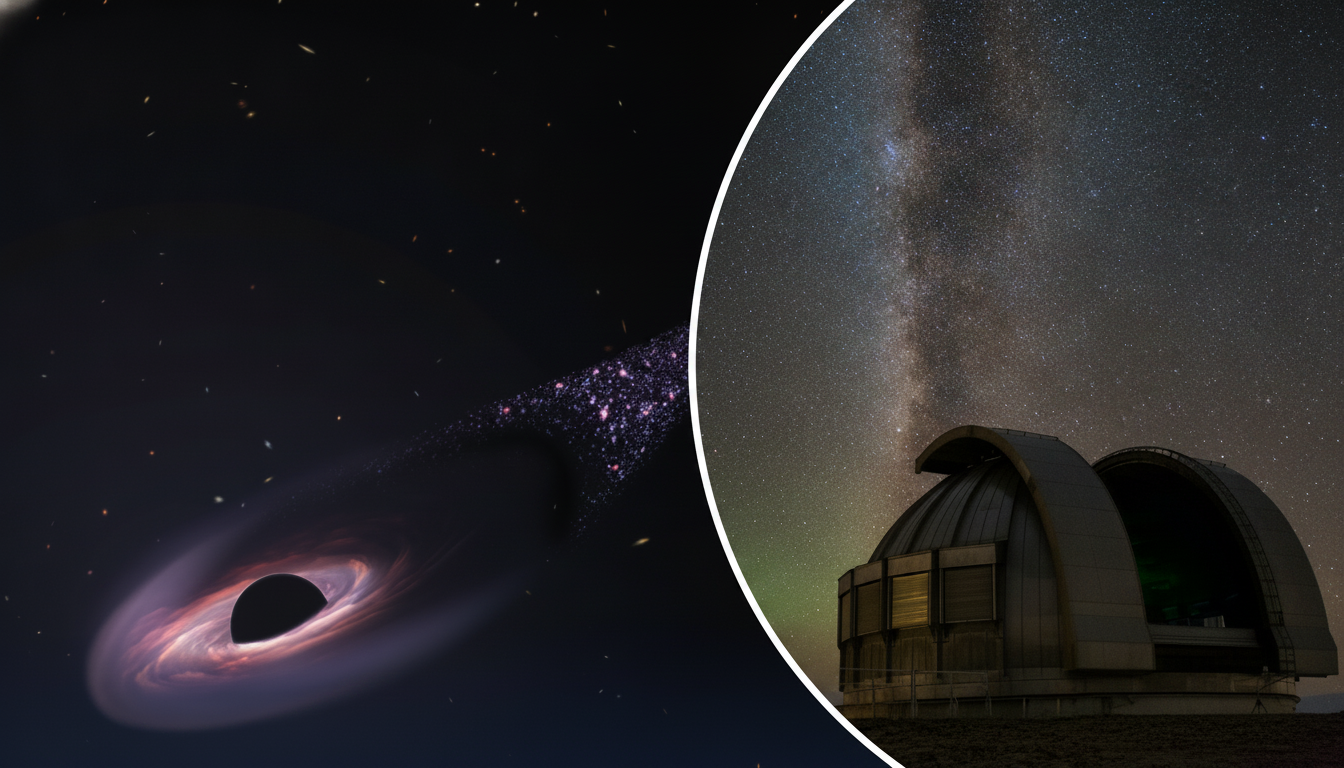
According to Novyny.live: For the first time, astronomers have captured a gravitational wave signal that likely originated from the vicinity of a newborn black hole's event horizon, following the merger of two black holes. The signal, designated GW250114, was recorded by the LIGO observatories and points to an unprecedented phenomenon in astrophysics.
Black Hole Merger
The collision of two black holes—with masses of roughly 34 and 32 times that of the Sun—resulted in the formation of a new black hole with a mass of about 63 solar masses. The oscillations detected after this merger lasted for approximately 0.2 seconds. Their frequency was around 200 hertz, a crucial detail for advancing research in this field.
The signal-to-noise ratio of the detected oscillations is approximately 16 to 17, confirming the reliability of the data. The direct wave associated with this signal is thought to have emerged near the event horizon during the formation of the new black hole. This breakthrough could significantly reshape our understanding of black holes and gravitational waves, opening new frontiers for astronomical exploration.
This detection has the potential to deepen our knowledge of the complex physical processes involved in black hole mergers. Studying the oscillations recorded in GW250114 may help astronomers better understand how matter behaves under extreme conditions and could validate theoretical models of black holes. The finding also underscores the importance of gravitational waves as a tool for probing the universe and its mysteries.
Read also
- Heatwave Alert: Temperatures to Hit +38°C Across Ukraine on June 27–28
- Syrskyi Reveals Size of Russian Forces in Ukraine and the Key Objective for Kyiv's Military
- Weekend Weather Forecast for Ukraine: Heat Peaking at +36°C and Thunderstorms on June 27–28
- Scorching Heat Up to 35°C: Weather Forecast for Ukraine on June 27
- 34th Station on Kyiv’s Green Line: Fascinating Facts About Slavutych Metro
- Ukraine Braces for Scorching Heatwave: Temperatures to Hit +40°C from June 28 to 30