Ukrainian 'Noosphere' First Crossed the South Pole Circle: Details of the Historic Mission.

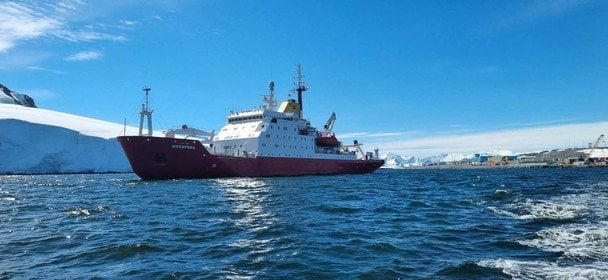
According to ТСН: The Ukrainian polar fleet 'Noosphere' made an important transition, crossing the South Pole Circle for the first time. The expedition left from the 'Academician Vernadsky' station through Margaret Bay to the British base 'Rothera' for conducting international research.
The National Antarctic Scientific Center explained that 'The Polar Circle is an imaginary line at a latitude of 66°33' (north - North Pole, south - South Pole), marking the boundary zones where polar day (the sun does not set) and polar night (the sun does not rise) are observed at least one day a year.'
The ship's route was complicated by icy conditions. The captain of the icebreaker Andriy Starish noted that the crew had to maneuver for more than two hours among icebergs. This required 'jeweler' work, maximum concentration, and a deep understanding of the ship's capabilities. The main goal of the expedition is to study the impact of global warming on Antarctica.
'Throughout the journey, oceanographers searched for marine heat waves, which periodically arise due to global warming even in the cold waters of Antarctica. To more accurately define the locations of climatic anomalies, seabed mapping was conducted using acoustic equipment,' the scientists reported.
Researchers used a special CTD probe to analyze temperature, salinity, and oxygen levels at 12 points in the Southern Ocean. Ukrainian and Mexican scientists also took sediment samples for further study of climate changes over thousands of years.
'In addition to working in the ocean, scientists visited 'Rothera'. This is the largest Antarctic station of Great Britain, where up to 100 polar explorers work in the summer and 22 in the winter. The possibilities of joint research, which are planned to start this season, were discussed. By the way, the temperature near 'Rothera' is the same as in Ukraine: from +1 to -2 C° (although it is summer in Antarctica, and winter in our country),' the scientists noted.
At this point, 'Noosphere' has completed this stage of the mission and is returning to the 'Academician Vernadsky' station for further research.
It is also worth noting that the Thwaites Glacier, which is considered one of the main triggers of possible sharp sea-level rise, is showing significantly faster rates of destruction than previously expected.
The scientists also demonstrated what Antarctica looks like without ice, highlighting the importance of their research in the context of global climate changes.
Thus, the 'Noosphere' expedition not only opens new horizons in the study of Antarctica but also draws attention to critical processes that affect the Earth's climate. The continuation of such missions can significantly assist in understanding and predicting environmental changes, as the situation in Antarctica has global significance for the future of our planet.
Read also
- NATO Allies Agree on Intelligence: Russia Could Attack the Alliance by 2029
- Romania Demands Self-Destruct Capability for Ukrainian Drones After Incident Near Constanța
- Drones Strip Russia’s ‘Novorossiya’ Highway of Strategic Value: Madar on Truck Restrictions
- Ukrainian Drones Stall Russian Army's Advance on Kupiansk Front: No Positions Lost
- IAEA Demands Iran Report on Uranium Stockpiles, Backed by U.S. and European Powers
- Germany’s Admiral Explains Why Ukraine Now Leads the World in Defense Innovation