A Luxurious Roman Bath Found in Ephesus: What the 1st-Century Artifacts Revealed.

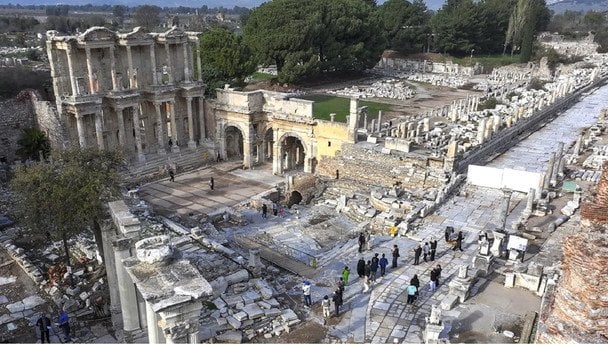
According to ТСН: In the ancient city of Ephesus, located in modern-day Turkey, archaeologists have uncovered a series of remarkable artifacts that shed light on the lives of wealthy residents during the Roman era and the history of one of the important centers of early Christianity.
Unusual Discoveries
During the excavation, researchers stumbled upon a luxurious marble bath from the 1st century AD, as well as a fragment of an ancient statue that had long served as part of the pavement.
The central artifact is a marble bath measuring approximately 1.5 meters long, made from the rare Greco Scritto marble with characteristic dark veins. According to the head of the excavation, archaeologist Serdar Aybek, this item dates back to the 1st century AD and, unlike the well-known public baths of Ephesus, was intended for private use.
Scientists believe that the bath belonged to the residents of the so-called “terraced houses” — an elite quarter of Roman aristocracy. Later, as research showed, this bathing device lost its original purpose and became a reservoir for water in a city fountain.
Torso of the Statue
Another unexpected find is the torso of a male statue, created at the end of the 1st century BC and the beginning of the 1st century AD. Archaeologists have established that after the destruction of the sculpture, its part was used as cobblestone. The torso was found face down in the pavement near the ancient stadium.
Ephesus holds a special place in the history of Christianity — the city is mentioned in the Bible as one of the seven churches of the Apocalypse, and in the 1st century, the apostle Paul preached here. The new discoveries complement a series of significant archaeological finds in the region from 2025–2026, including the discovery of an ancient Christian mosaic in Urfa, the ruins of a Roman assembly hall in Laodicea, and a complex of 6th-century Christian tombs in the Syrian province of Idlib.
These findings vividly confirm the rich historical context of Ephesus and its significance in the early Christian world. Archaeologists continue their research, hoping to find even more unique artifacts that will help better understand the culture and everyday life of the inhabitants of this ancient city.
Read also
- China Deploys HIMARS for the First Time Toward the Taiwan Strait: Exercise Breakdown
- Overnight on June 11, Russia Launches 221 Drones and Two Missiles in Massive Assault on Ukraine
- 1,310 Russian invaders eliminated in a single day: Ukraine’s military reports major blow to Moscow’s forces
- Ukraine’s Air Force Downs 195 Russian Drones: Strike Locations and Aftermath Revealed
- Nearly 530 Drones Launched by Russia in a Single Week: Zelenskyy Highlights the Critical Weapon Needed
- Frontline Dynamics Shift: Chongar Bridge Destroyed, FP-5 Flamingo Missiles Deployed for the First Time