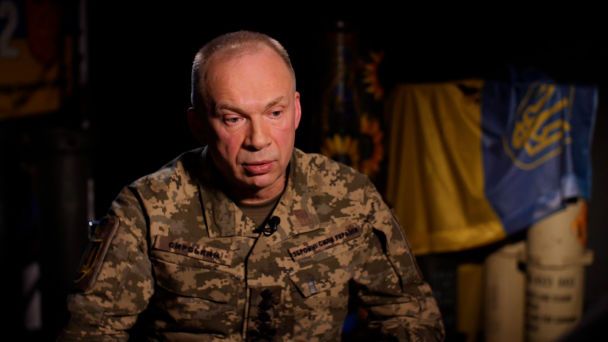
Syrskyi explained the withdrawal from Siversk: why a difficult decision was made.

Withdrawal from Siversk
According to ТСН: The defense of Siversk became complicated, so it was unacceptable to leave military units there.
Commander-in-Chief of the Armed Forces of Ukraine Oleksandr Syrskyi noted in an interview that the Serebryansky forest, Bilohorivka, and Siversk are territories where serious battles took place during World War II. The landscape of this area includes dominant heights and chalk mountains, similar to those in Bilohorivka, which provide the opportunity for a sustainable defense.
The general added that this direction had not been a priority for a long time, as the enemy had no opportunity to conduct offensive actions.
“Gradual actions were taken. Yes, brigades stood there. They continued to advance, but the intensity of hostilities was lower than in other directions,” the general notes.
Syrskyi explained that in this region, more emphasis was placed on diversionary and maneuver groups, infantry, as well as Special Operations Forces. The concentration of drones with fiber-optic control led to Ukrainian units starting to retreat deeper, leaving the infantry without cover.
“In these conditions, the defense of Siversk became problematic, to put it mildly. It would have been wrong to leave the troops, the parts, the units that defended there to simply die. Therefore, a corresponding decision was made. We withdrew to dominant heights. There are places to retreat. The enemy is also trying to take advantage of this, but it's not working. Appropriate actions are planned in this direction. That's all I can say about this direction,” explained the Commander-in-Chief of the Armed Forces of Ukraine.
It was also reported that Ukrainian defenders have withdrawn from Siversk.
The abandonment of Siversk reflects the complex situation on the front, where Ukrainian forces are trying to adapt their strategy in the face of constant challenges. The choice to retreat to more advantageous positions indicates a desire to preserve their forces and prepare for future actions. After all, in the conditions of active hostilities, it is important to maintain the potential for new counterattacks.
Read also
- Ceasefire Not Putin’s Goal: Expert Identifies Key Hurdle to Peace
- Drone Strikes Shatter Putin's Security Narrative: What Happened at the St. Petersburg Forum
- A New Signal to Washington and Europe: Zelenskyy Pens an Open Letter to Putin
- NATO Eyes €70 Billion Aid Package for Ukraine – What’s Inside the Proposal
- Armenia’s Ruling Party Seeks to Disqualify Rivals from Election Over Bribery Allegations
- Xi Jinping to Visit North Korea for the First Time in Seven Years: Key Details on the Upcoming Trip