Ukraine's Debt Surpasses $210 Billion: A Breakdown of Hourly Fluctuations.

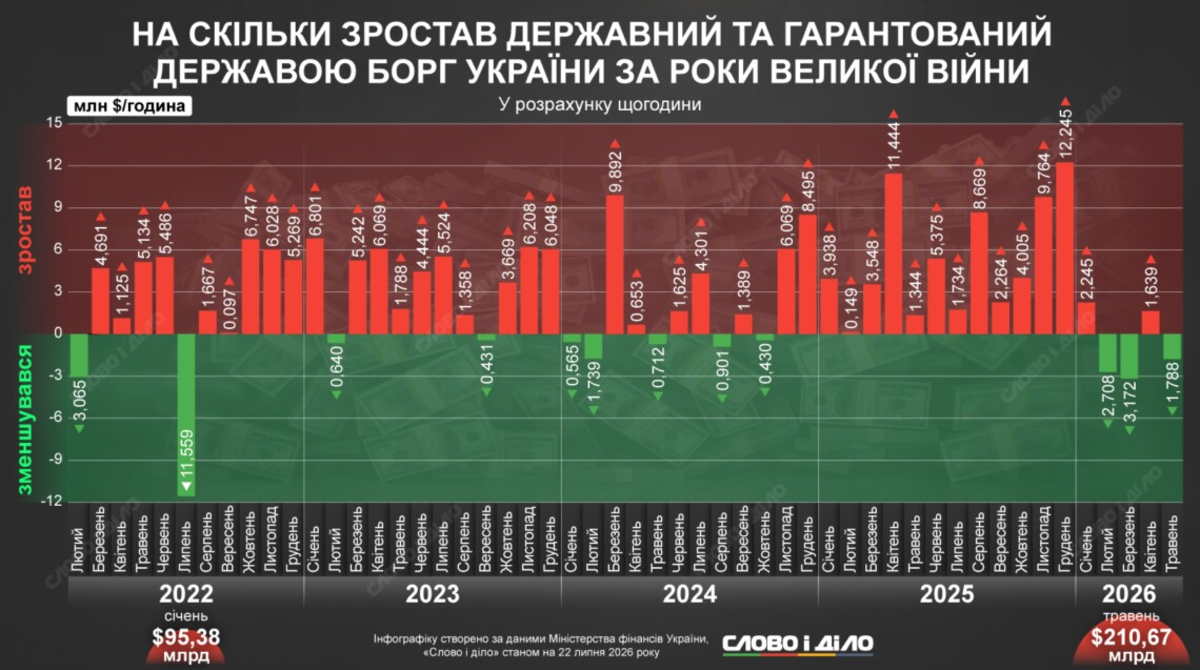
Examining Ukraine's State and Guaranteed Debt (2022–2026)
According to Слово і Діло — Інфографіка: An analysis of Ukraine’s sovereign and state-guaranteed debt from 2022 through 2026 reveals dramatic shifts driven by the economic impact of war. As of January 2022, just before Russia’s full-scale invasion, Ukraine’s public debt stood at $95.38 billion. Over the following years, the debt experienced alternating periods of reduction and growth, reflecting the country's financial challenges during wartime.
Year-by-Year Debt Trends
In February 2022, the national debt was shrinking by $3.065 million per hour. This trend reversed in May 2022, when the combined state and guaranteed debt began rising at a rate of $5.134 million per hour. July 2022 saw another reduction, with debt falling by $11.559 million per hour. During October and November 2022, debt once again increased, climbing by $6.747 million and $6.028 million per hour, respectively.
In 2023, debt decreased only in February (by $0.640 million per hour) and September (by $0.431 million per hour). In 2024, hourly reductions occurred in January, February, May, August, and October. However, March 2024 recorded a significant spike, with debt growing by $9.892 million per hour, followed by a $8.495 million per hour increase in December.
The trend continued into 2026. In January, debt rose by $2.245 million per hour, then fell by $2.708 million per hour in February and $3.172 million per hour in March. By May 2026, Ukraine’s state and guaranteed debt had reached $210.67 billion.
Sovereign debt refers to all direct borrowing by the Ukrainian government, while guaranteed debt includes liabilities of state-owned enterprises and institutions that the government backs. This analysis highlights how the war has reshaped the country’s financial landscape, forcing the government to navigate ongoing economic pressures.
The increase in Ukraine’s national debt during the war underscores the urgent need to finance military operations and support economic recovery.
The government must continuously adjust its debt management strategies in response to financial instability. Rising debt levels could carry long-term consequences for Ukraine’s economic stability, making it crucial to monitor future developments in this area.
Read also
- Russia Sets Record in Gold Sell-Off: What It Signals for the Economy
- Putin’s Economic Claims Exposed as Manipulation by Ukraine’s Disinformation Center
- Rheinmetall to Double Gunpowder Output: What This Means for Ukraine
- Azerbaijan Steps Up as Europe's Energy Alternative: Gas Deliveries to Germany Already Underway
- IMF Demands Utility Rate Hikes as Naftogaz Debt Surges 63%
- 12 Red Flags for Shell Companies Identified by Ukraine's Central Bank: Banks Ordered to Scrutinize Importers