Ukraine's vegetable exports collapse: tomato shipments drop 16-fold, onion exports plummet 53-fold.

How the war reshaped Ukraine's vegetable export landscape
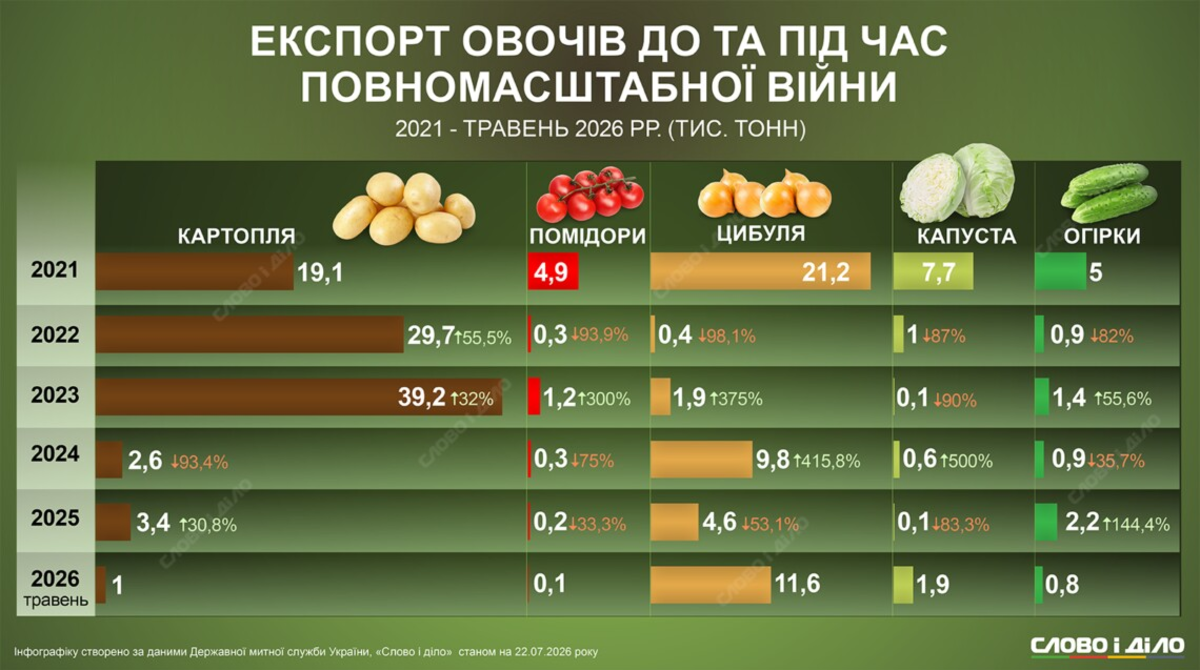
According to Слово і Діло — Інфографіка: Russia's full-scale invasion in 2022 dealt a severe blow to Ukraine's vegetable export volumes and revenues. The declines were dramatic across key crops:
- Cucumber exports shrank by a factor of 5.5,
- Cabbage exports fell nearly 8-fold,
- Tomato exports dropped 16-fold,
- Onion exports plunged 53-fold.
These numbers highlight the immense challenges Ukrainian farmers have faced during the war.
Shifts in vegetable export volumes and earnings
To understand the scale of the collapse, it helps to look at pre-war figures. In 2021, Ukraine exported:
- 19,100 tonnes of potatoes,
- 4,900 tonnes of tomatoes,
- 21,200 tonnes of onions,
- 7,700 tonnes of cabbage,
- 5,000 tonnes of cucumbers.
Potato exports initially defied the trend, rising to 29,700 tonnes in 2022 and further to 39,200 tonnes in 2023. But by 2024, they had fallen to just 2,600 tonnes. As of May 2026, Ukraine had exported:
- 1,000 tonnes of potatoes,
- 100 tonnes of tomatoes,
- 11,600 tonnes of onions,
- 1,900 tonnes of cabbage,
- 800 tonnes of cucumbers.
Revenue from vegetable exports tells a similar story. In 2022, cucumber export earnings fell by a factor of 3.5, tomato revenue dropped 6.5-fold, onion income declined more than 16-fold, and cabbage earnings shrank 2.5-fold. By 2023, potato export revenue had recovered to $5.8 million, signaling a partial market rebound. However, cabbage export revenue stood at just $0.3 million in 2024 and fell further to $0.05 million in 2025.
Overall, the data on Ukraine's vegetable export volumes and revenues point to profound shifts in the agricultural sector driven by the war. These disruptions have directly undermined the country's ability to supply international markets.
The situation in Ukraine's agricultural sector illustrates how armed conflict can fundamentally reshape economic indicators. It underscores the critical need for sound agricultural policies and strategies to maintain food security amid the challenges of wartime conditions.
Read also
- UK Greenlit to Join EU's €90 Billion Loan Program for Ukraine
- Online Lending in Ukraine: Key Rules for Staying Financially Safe
- Fuel Prices in Ukraine Surge to 83 Hryvnias: A Five-Year Price Evolution
- Russia Halts OFZ Auctions After Market Crash as Budget Deficit Hits 5.7 Trillion Rubles
- ATB and S.T.A.L.K.E.R. 2 Joint Initiative Named Finalist at Prestigious European Awards
- Fuel Shortage Spreads Across Russia as Moscow Diverts Siberian Gasoline Supplies