Hubble Unveils Secrets of the Lost Galaxy: New Data on Star Formation.

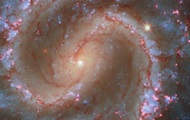
New Image of Galaxy NGC 4535 from the Hubble Telescope
According to Korrespondent.net: The Hubble Telescope has presented a detailed image of the spiral galaxy NGC 4535, located approximately 50 million light-years away in the constellation Virgo.
This galaxy, due to its faint visibility in small telescopes, is called the 'Lost' galaxy. However, thanks to its 2.4-meter diameter mirror, Hubble has been able to reveal its structure in details that are not accessible for ground-based observations. This image was published by the European Space Agency.
The new image shows numerous young star clusters located along the spiral arms. Many of these clusters are surrounded by pink light from gas clouds known as H II regions, where hot and massive stars are being formed. Such stars emit intense light, heating the surrounding gas, and eventually explode as supernovae, significantly altering the structure of the galaxy.
Studying the Galaxy as Part of the PHANGS Program
This image is part of the PHANGS program, which aims to catalog about 50,000 H II regions in various galaxies. Compared to observations from 2021, new data has provided a different perspective on the galaxy and displayed the bright red glow of the nebulae surrounding stars in their first millions of years of life.
Astronomers hope that these new observations will help better understand how young stars interact with interstellar gas and shape the appearance and evolution of spiral galaxies like the 'Lost' NGC 4535.
It was previously reported that the brightness of the interstellar comet 3I/ATLAS, which approached the Sun, is increasing much faster than researchers expected.
Astronomers have captured a star in the moment of turning into a supernova for the first time
News from Korrespondent.net on Telegram and WhatsApp.
This image of NGC 4535 highlights the importance of modern technologies in studying space. The PHANGS program, under which this image was obtained, opens new horizons for astronomy, allowing researchers to better understand star formation processes and the evolution of galaxies. Thanks to such observations, scientists have the opportunity to revisit ideas about the origin and development of our Universe.
Read also
- Antique Musket Balls Repurposed Into Solar Cells with 94% Efficiency
- South Korea Patents a Silent Engine for Air Taxis
- 144 FPS at 4K: A Gamer Pairs an RTX 3090 and RTX 3050 for Stunning Performance
- Snapdragon 8 Elite Gen 5: Qualcomm’s New Chip Targets Sub-$600 Smartphones
- Samsung Unveils Three New Odyssey Gaming Monitors: Specs and Features Revealed
- Plastic Waste Converted into Jet Fuel: New Breakthrough by Chinese Researchers