Hubble took a unique photo of the birth of a new star: what the telescope showed.

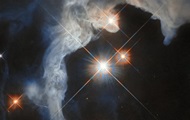
The Hubble Space Telescope captured a new nebula GN 04.32.8 - a blue cosmic formation in one of the most famous star formation zones - the Taurus Molecular Cloud. The photo was published by the European Space Agency.
This nebula does not emit light on its own - it is illuminated by neighboring stars. Dust particles scatter the light, so the cloud takes on a characteristic blue hue, similar to the daytime sky on Earth.
Studying the new nebula in the cosmic formation
GN 04.32.8 is located 480 light-years away from Earth, making it an interesting object for study. In the center of the frame, three bright stars can be seen: V1025 Tauri and its 'satellites' HP Tau, HP Tau G2, and HP Tau G3, which belong to the T Tauri class - very young, active stars that are forming.
The protostar that is just being born is the main highlight of the photo. This is the orange spot at the center of the image, which is partially obscured by a protoplanetary disk that blocks the light. The disk is oriented sideways towards Earth, allowing for the study of its structure and the examination of planet formation processes around new stars.
These observations open new opportunities for understanding the processes of star birth and planetary systems in our galaxy.
Discoveries in space from scientists
It was previously reported that impressive cosmic structures are occurring in the galaxy cluster Abell 2255, located about 800 million light-years from Earth.
The James Webb Telescope captured a clear photo of a distant planet for the first time
News from Korrespondent.net on Telegram and WhatsApp. Subscribe to our channels and WhatsApp
The announcement of the new nebula GN 04.32.8, captured by the Hubble Space Telescope in the Taurus Molecular Cloud, speaks of ongoing discoveries in the galaxy. Scientists note that this discovery provides new opportunities for exploring the processes of star and planet formation in space and helps to better understand our galaxy.Read also
- Antique Musket Balls Repurposed Into Solar Cells with 94% Efficiency
- South Korea Patents a Silent Engine for Air Taxis
- 144 FPS at 4K: A Gamer Pairs an RTX 3090 and RTX 3050 for Stunning Performance
- Snapdragon 8 Elite Gen 5: Qualcomm’s New Chip Targets Sub-$600 Smartphones
- Samsung Unveils Three New Odyssey Gaming Monitors: Specs and Features Revealed
- Plastic Waste Converted into Jet Fuel: New Breakthrough by Chinese Researchers