In China, flying cars collide for the first time in history: one pilot injured.

Collision of flying cars in China
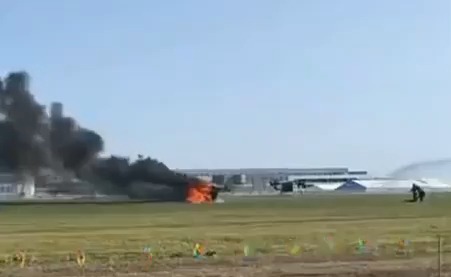
According to The Sun: An astonishing incident occurred during an air show in China when two flying cars collided at altitude. One of the pilots was injured, resulting in one of the aircraft falling to the ground, sparking a large fire.
Two flying cars collided during the show rehearsal X/@vani_mehrotra Thick black smoke rises into the air X/@vani_mehrotra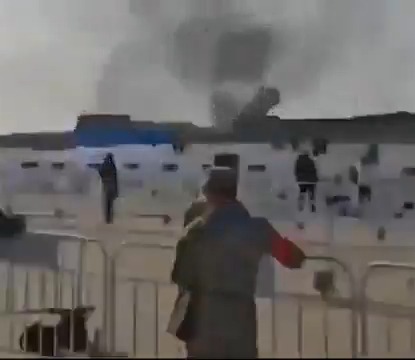 Fire trucks rushed to the scene of the horrifying collision
X/@vani_mehrotra
Alamy
Fire trucks rushed to the scene of the horrifying collision
X/@vani_mehrotra
Alamy
Emergency services were called to the crash site in Changchun, the capital of the northeastern province of Jilin, this afternoon. This case is considered the first of its kind, where flying cars collided in the air.
Video footage shows thick black smoke rising from one of the aircraft as flames engulf the structure.
Fire trucks arrived at the scene, while witnesses watched in horror.
It turned out that the flying cars, developed by Xpeng Aeroht, a subsidiary of the Chinese electric vehicle manufacturer Xpeng, collided due to 'insufficient distance' while performing stunts.
In a statement published by CNN, the company mentioned that one of the cars 'sustained fuselage damage and caught fire after landing'.
Local authorities took urgent 'emergency measures' at the site, confirming that no one was seriously injured.
One of the company's employees, who remained anonymous, reported that the pilots were performing 'complex' maneuvers during the show.
Development of China's low-alternative economy
This incident occurred against the backdrop of China's plans to develop a 'low-alternative economy' that includes flying taxis, drones, and other innovative airborne vehicles.
According to a recent report by the China Low-Alterative Economy Alliance, networks of aerial transport and ground infrastructure for flying vehicles are to be completed within the next two to three years.
This infrastructure will enable mass production and commercialization of electric vertical takeoff and landing (eVTOL) aircraft by 2026.
Currently, eVTOLs cost around 10 million yuan (about 1 million pounds), but forecasts suggest a significant drop in prices by 2030.
A family flying car for four or five passengers may cost between 200,000 to 300,000 pounds (2 to 3 million yuan), making them more accessible in the luxury market.
The development of artificial intelligence and drone technology will be key to realizing this vision.
Flying vehicles are expected to become commonplace in logistics, agriculture, urban management, tourism, and rescue operations.
Drone technologies are also rapidly evolving. For example, Beijing-based i-Kingtec has already developed fully autonomous drone garages capable of servicing large areas.
These drones are used for inspecting power lines and monitoring the environment.
As this industry develops, safety and regulation remain a priority.
Technologies for detecting and managing rogue drones will become extremely relevant, especially near sensitive sites such as airports and power plants.
Companies are collaborating with authorities to establish no-fly zones and ensure safe operations.
China anticipates a 'golden decade' for its low-alternative economy, which includes drones and eVTOL.
This sector is projected to grow to an astonishing 3 trillion yuan (326 billion pounds) by 2030.
Company Ehang, a leader in this field, has already delivered around 300 electric aircraft EH216-S and recently completed test flights using the latest solid-state batteries.
Other companies, such as Xpeng Aeroht, plan to begin mass production by 2026, with prices starting from 2 million yuan.
Black smoke filled the air
X/@vani_mehrotra
After this incident, attention to pilot safety and technology becomes even more crucial. Thus, the events at the air show in China highlight the need to enhance safety standards in the field of new vehicles, which may affect the future development of the industry.
China continues to bet on innovation in air transport, which opens up new opportunities but also presents challenges related to safety and regulation. Monitoring these processes will remain important for future achievements in this field.
Read also
- Ukraine Signs Six 10-Year Agreements Under the Drone Deal Initiative, with 20 More Countries Set to Join
- Overnight Air Defense Takes Down 83 Targets as Russia Launches Missiles and 105 Drones
- US Lawmakers Urge Immediate Aid for Ukraine After Deadly Kyiv Strike: 30 Killed
- July 3rd Drone and Missile Onslaught on Ukraine: Air Defense Downs 82 Drones, Hits Recorded at 16 Sites
- Strike on Dubno Communications Hub: Russia Faces Disruption to Satellite Internet
- Ukrainian Forces Eliminate 1,250 Russian Troops in a Single Day: New Toll on Moscow’s Equipment and Personnel