Giant iceberg A-23A melts before our eyes: NASA shows final phase.

According to ТСН: The iceberg A-23A, which has been under observation by scientists for a long time, is nearing the end of its life. After drifting into the warm waters of the South Atlantic, it began to actively disintegrate.
Why it turned blue
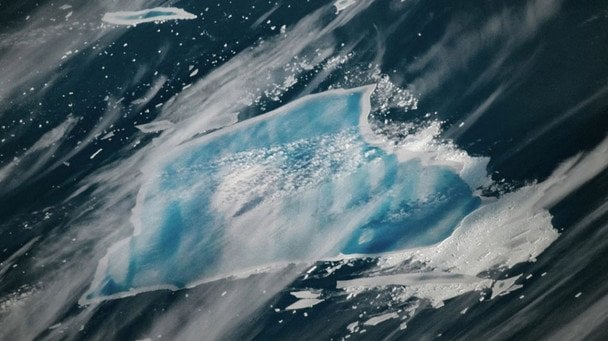
At the end of December 2025, the Terra satellite recorded that the surface of the iceberg was covered with large pools of meltwater, known to researchers as 'blue slush.'
This phenomenon was explained by Ted Scambos, a senior research scientist at the University of Colorado Boulder:
'The weight of the water accumulates inside cracks in the ice and causes them to open up.'
Scientists also noticed an interesting effect of 'glacial moats': a thin white line along the edges that restrains the blue water. This occurs because the edges of the iceberg are melting from below and bending upwards.
History of the giant
A-23A broke off from the Filchner Ice Shelf in Antarctica back in 1986.
Then: Its area was over 38,000 sq. km (approximately the size of two regions of Ukraine).
Now: According to the National Ice Center of the United States, it has decreased to 1,180 sq. km, but it is still larger than the area of New York.
The photo also shows blue-white streaks – these are 'scars' from rubbing against the bottom of Antarctica, which have persisted for hundreds of years.
The prognosis is grim
Chris Shuman, a scientist at the University of Maryland, believes that the iceberg could completely break apart in the coming weeks.
'I certainly don't expect A-23A to survive the Australian summer [summer in the Southern Hemisphere lasts from December to February – ed.],' noted the researcher.
Currently, A-23A is drifting in an area that glaciologists call the 'iceberg graveyard.' Warm air, water, and climate change are accelerating its demise. The images show signs of 'breaching,' where water under pressure breaks through the walls of the iceberg and spills into the ocean.
At the same time, scientists remind us that new giants are on the horizon. Icebergs A-81, B22A, and D15A are already preparing to begin their journey north, repeating the fate of their predecessor.
It is worth noting that a unique iceberg resembling a 'sandwich' made of white ice with a blue layer has been spotted in Antarctica. This is a result of meltwater freezing in a crack of the glacier.
The death of iceberg A-23A serves as a vivid reminder of the consequences of climate change that we face. The continuous melting of the Antarctic ice not only serves as evidence of global warming but also has potentially serious impacts on sea levels. This underscores the importance of scientific research in this area and the need to take action against climate change.
Read also
- Russian Forces Push to Isolate Kostiantynivka's Industrial Zone as Fighting Erupts
- IAEA and 47 Nations Condemn Russian Strike on Ukraine's Nuclear Waste Storage Facility
- Russia's Supply Line Crippled: Bridge Strikes in Chongar Cut 100 km of Logistics
- Germany Pledges €300 Million to Czech-Led Ammunition Plan, Securing 50,000 Shells for Ukraine
- Mariupol Port Destroyed by Azov and SBU Forces, Cutting Off Russia’s Sea Access
- Ukrainian Forces Push Back Russian Army on the Alexandrovsk Front: New Gains Reported