Russia Attacks Logistics on the Bakhmut Front: How Ground Robots Resist DRGs.

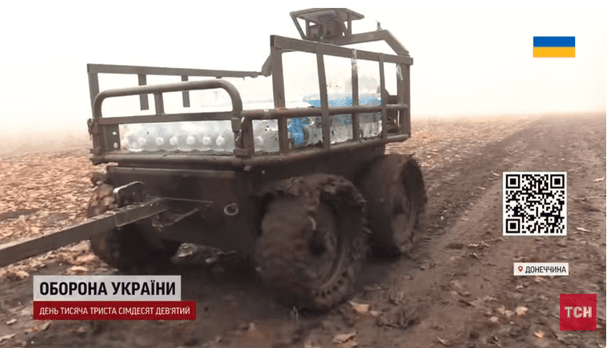
According to ТСН: On the front near the Bakhmut-Kramatorsk segment, the enemy has intensified its activity. Here, diversionary-reconnaissance groups of the third Russian Combined Arms Army are mainly operating, aiming to disrupt communications between the Ukrainian rear and the front.
Military companies of ground robotic complexes (GRC) of the 30th separate mechanized brigade named after Prince Konstantin Ostrozhsky actively resist these intentions, using remotely piloted 'iron assistants'.
'The enemy, as he advances, avoids and tries to maximize avoidance of passage through our combat formations. He seeks to find uncovered seams, uncovered areas,' he says.
The Enemy's New Tactics: Avoiding Combat and Cutting Logistics
The commander of the 'Sapsan' drone battalion of the 30th Mechanized Brigade noted that currently there are practically no mechanized assaults, but the situation remains tense. The deputy commander of the GRC company with the call sign 'Dymok' emphasized that infantry assaults continue at the front, and continuous hunting is conducted in the air.
'The activation of FPV drones has increased. There are many 'waiters' among FPV drones. Our biggest problem and greatest difficulty in any logistics missions right now is with the 'waiters',' says 'Dymok'.
The main goal of the enemy's diversionary-reconnaissance groups is to cut logistics and isolate Ukrainian positions from supplies.
'Iron Assistants' at the Front
The GRC company of the 30th brigade provides logistical support to the front line—both for infantry and for UAV crews and mortar positions.
'The core right now is logistical support at the front line. For both infantry and UAV crews.'
The mobile group of the GRC company constantly tries to deliver its robots as close to the combat line as possible. Drivers avoid dangerous areas and try to quickly deliver the GRC to the front.
'To the farthest point, where it can be reached more or less safely, and then we unload the GRC,' says 'Sonic', the operator of the mobile GRC group.
Evacuation Under Fire
The landing zone for the GRC is constantly under enemy fire, complicating access to the front. One of the ground robots was recently hit by FPV drones, but it was managed to be rescued.
Today, this GRC has already been repaired and is ready for new missions.
Kamikaze Robots and Miners
Ground robots can perform not only logistical tasks but also engage in combat.
'There are missions for mining; it's like in front of the enemy, it's like behind the enemy...'
The use of remotely piloted mechanical assistants significantly reduces risks and ensures uninterrupted supplies for infantry.
The situation at the front remains complicated, as the enemy employs new tactics to disrupt the logistics of Ukrainian forces. However, the evolution and implementation of new technologies, such as remotely piloted robots, provide Ukrainian military with an advantage in this fight. These innovations significantly enhance efficiency and safety when carrying out tasks at the forefront, which, in turn, helps save the lives of soldiers and maintain front positions.
Read also
- Russia's Nuclear Deterrence System Has Been Broken: What This Means for Ukraine
- Trump sparks Kremlin confusion as Peskov and Zakharova contradict each other
- France and Poland Launch Nuclear Security Group: What It Signals for NATO
- Satellite Imagery Reveals Iran Reactivating Nuclear Sites After US Deal
- Nearly $3 Million Paid: U.S. Issues First Compensation for 'Havana Syndrome' Victims
- Russia’s Strategic Position Deteriorates as Ukraine Intensifies Counteroffensives: Frontline Analysis