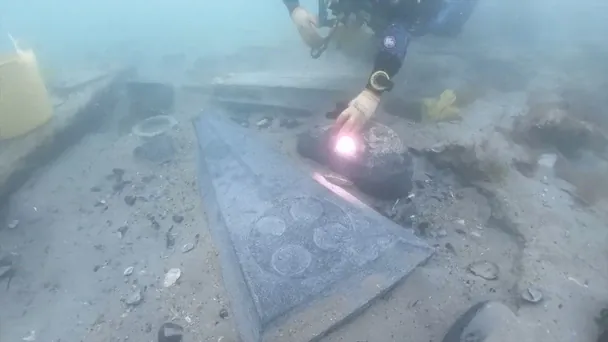
In England, a 13th-century medieval slab has been raised from the depths: a finding from a sunken ship.

Presentation of the new exhibition at the Poole Museum
According to ТСН: A new exhibition has opened at the Poole Museum, featuring a rare find—a medieval gravestone slab recovered from the site of a sunken 13th-century ship off the coast of Dorset. The artifact was discovered in the wreckage of the trading ship Mortar Wreck, resting at the bottom of Studland Bay, approximately 1.6 kilometers from the Isle of Purbeck.
This area was long considered an ordinary pile of stones, but research conducted between 2019 and 2020 revealed that the hull of one of England's oldest ships was preserved underwater. In 2022, the remains of the vessel, dated to around 1250, were officially listed as protected objects.
During archaeological investigations at the site, a stone cauldron, wooden beams of Irish origin, and two gravestones made of Purbeck stone were found. This material has been extracted from Purbeck since Roman times, and in the Middle Ages, it was considered especially valuable—used in the construction of the Tower of London and Westminster Abbey. Samples of Purbeck marble have even been found beyond Britain, such as in Denmark.
The expedition leader, marine archaeologist Tom Cousins from Bournemouth University, noted that divers previously avoided this site, considering it underwater debris. Only the initial discoveries proved that a well-preserved fragment of the trading history of the 13th century lies here.
Preliminary estimates suggest that the cause of the ship's sinking may have been overloading—approximately 30 tons of stones were on board. A crack was also found in the hull that could have expedited the disaster. In design, the ship resembled modernized Viking variants.
Archaeologists emphasize that underwater excavations allow us to 'freeze a moment in time': all discoveries belong to one period, helping to more accurately recreate the everyday life and trade routes of medieval England.
In the Poole Museum exhibition, the artifacts are presented alongside other maritime relics, including finds from a sunken 17th-century trading ship discovered nearby the harbor. Museum representative Joe Raines characterized this discovery as impressive, allowing modern visitors to feel a living connection with the people who lived here nearly 800 years ago.
It is important to note that the opening of the new exhibition at the Poole Museum is a significant event for archaeology and the history of medieval ownership of maritime trade. Research conducted at the site of the sunken ship opens up numerous opportunities for scientists to gain deeper insights into the history of this region. Furthermore, these findings underscore the importance of preserving cultural heritage, which can teach us about our roots and connection to the past.
Read also
- Ukraine Gains the Upper Hand in the War: What Shifted the Battlefield Dynamics
- Even Without a Defeat, Ukraine Could Still Lose the War: Rethinking What 'Victory' Really Means
- Norway Steps Up Nuclear Safety Support for Ukraine Following Chernobyl Attack
- Ukraine Cuts Off Crimea from Russia: Traffic on the R-280 Highway Plummets by 71%
- Weapon Shortages Hit Russian Forces in Crimea: What’s Happening to Their Supply Lines?
- Ukraine Aims to Cut Off Crimea and Destroy Russian Targets with Drone Strikes