Ukrainians Are Buying More Imported Clothing and Leather as Footwear Exports Decline.

Shifts in Ukraine’s Textile Trade: Imports Rise While Exports Falter
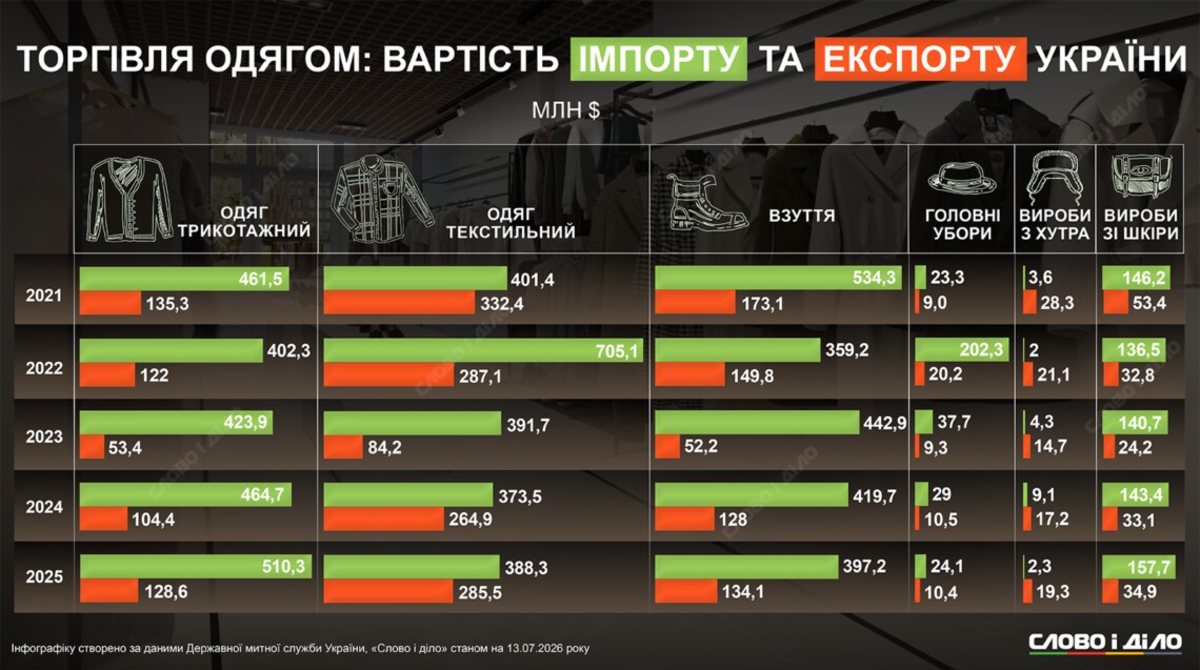
According to Слово і Діло — Інфографіка: Since the start of the full-scale invasion, Ukraine has experienced notable changes in the value of imported knitted garments and leather goods, while its footwear export volumes have dropped. In 2021, the country imported knitted clothing worth $461.5 million. That figure fell to $402.3 million in 2022 but rebounded to $510.3 million in 2023. On the export side, knitted clothing sales abroad totaled $135.3 million in 2021, only to shrink to $53.4 million by 2023.
A similar pattern emerges for textile-based apparel. Imports of textile clothing reached $401.4 million in 2021, surged to $705.1 million in 2022, but then declined to $388.3 million in 2025. Exports of textile clothing, which stood at $332.4 million in 2021, dropped to $285.5 million in 2025.
Trends in Fur and Leather Goods Trade
For fur products, Ukraine imported $3.6 million worth in 2021, with imports falling to $2 million in 2022. However, by 2024, fur imports had climbed to $9.1 million. Fur exports, which were $28.3 million in 2021, decreased to $19.3 million in 2025.
Leather goods imports rose from $146.2 million in 2021 to $157.7 million in 2025. As for footwear, Ukraine imported $534.3 million worth in 2021, but that amount dropped to $359.2 million in 2022. Footwear exports fell from $173.1 million in 2021 to $134.1 million in 2025.
Additionally, imports of headwear reached $202.3 million in 2022. These figures highlight how the full-scale war has reshaped Ukraine’s trade patterns in textiles, knitted apparel, and footwear.
These fluctuations in import and export values reflect the war’s ongoing impact on Ukraine’s economy.
The decline in exports and the volatility of imports underscore the challenges Ukrainian producers face in global markets, as well as the market’s adaptation to new realities. It is crucial for both government authorities and the business community to respond to these shifts in order to sustain economic stability and support recovery during wartime.
Read also
- Europe Paid Up to €6 Billion for Russian Gas — Who Bought the Most?
- Over 1.2 Million Hectares of Land Sold in Ukraine in Five Years: A Look at Price Trends
- Fuel Crisis Looms in Europe as U.S.-Iran Tensions Drive Up Oil Prices
- Fuel Shortage Spreads to 78 Russian Regions as Gasoline Prices Jump 7%
- Fuel Shortage in Russia Sparks Alarm in Ukraine Over Potential Crop Losses for Farmers
- Gas Shortages and Mass Bankruptcies Hit Russia: Could Trump Change the Equation?