The riddle of stainless steel: how to say it correctly in Ukrainian?.

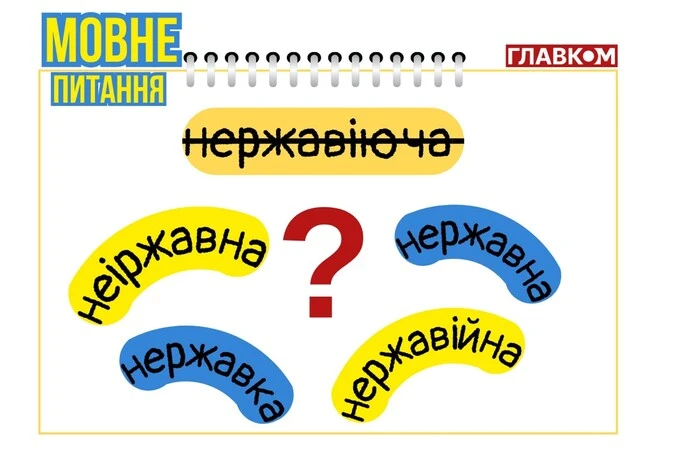
Throughout the 20th century, Ukraine, which was under the influence of the Soviet Union, used the Russian language as the official language and the language of instruction in many universities, especially in technical specialties. This continued even after the country gained independence. However, the war between Russia and Ukraine has stimulated the revival of Ukrainian terminology. Language scholar Olga Vasilyeva discusses this in the 'Language Question' section on the Glav.com website.
During the Soviet era, Ukrainian technical terms were often borrowed from the Russian language. But this development of Ukrainian terminology took place over a very short period - from the 1920s to the 1930s. After that, many linguists working on Ukrainian technical terminology were repressed.
Now let's consider whether Ukrainian has enough resources to create its own technical terms. It has a large number of such resources, so many that sometimes it is difficult to choose the correct option.
For example, for the phrase 'stainless steel', philologists offer several alternatives: 'neirzhava', 'nerzhava', 'nerzhavka', 'nerzhavyna'. Ukrainian dictionaries confirm that the verbs 'rzhavity' and 'irzhavity' are synonyms, while in colloquial language, the most common variant is 'nerzhavka'. However, well-known linguist Alexander Ponomaryov suggests using 'nerzhavna'.
Ukrainian has a rich vocabulary and effective mechanisms for creating new terms. For instance, in the construction field, the word 'trimkist' was proposed by Professor Vitaliy Morhunyk in the 1990s. The Russian language does not have a corresponding word, there is only 'prochnost', while Ukrainian has 'mitsnist' and 'trimkist', which denote different concepts.
The revival of Ukrainian terminology, which began after the start of the Russo-Ukrainian war, is an important component of the country's cultural and scientific independence. Linguists must continue the work of their predecessors from the period of Ukrainization so that technical disciplines develop in the Ukrainian language.
It is also worth mentioning that the word 'kofe' is not a literary norm in the Ukrainian language, as noted by Olga Vasilyeva in the 'Language Question' section. Earlier, she explained a mistake that Ukrainians often make, confusing the words 'otzhe' and 'vidtak'.
Olga Vasilyeva also analyzed the lyrics of Olya Polyakova's song and found out whether the word 'svobodny' exists in the Ukrainian language. It turned out that Olya Polyakova translated her song 'Queen of the Night' so that she now sings, 'You are now free, go wherever you want...'.
Read also
- Gallery Vandalized in Warsaw After Employee Protests Anti-Ukrainian Slogans
- Ukrainians File Over 1,300 Language Complaints in Six Months
- Veterans Offered Salaries as Low as 10–12 Thousand: Alarm Bells Ringing in Lviv
- Up to 3,100 UAH: Pension Fund Reveals Who Qualifies for Independence Day Payments
- Veteran Employment Unit Launched in Lviv: The Post-War Challenges They Face
- Registration Opens July 6 for Koriukivka Residents to Receive UAH 10,800 in Aid