The Ukrainian Army has built a fortress in Donbass with a width of 200 meters: how it would change the course of the war.

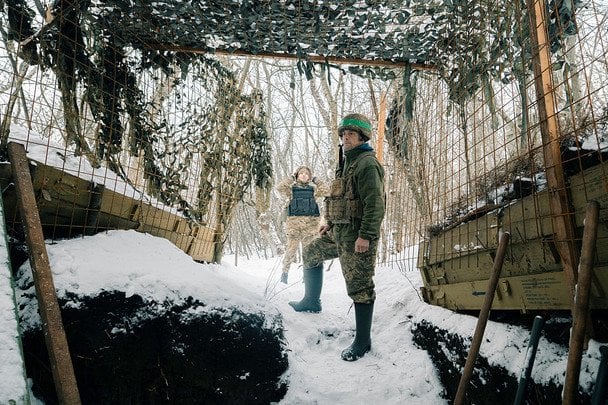
According to ТСН: The Ukrainian Armed Forces have created a multi-tiered defense system in Donbass, with a width of 200 m, consisting of tank trenches, minefields, and concrete obstacles. The military is convinced that the situation at the front would have been fundamentally different if such a fortress had existed at the beginning of the Russian invasion in 2022.
Details of the defense line in Donbass
The defensive structures in Donbass stretch to the horizon. They are part of a large fortification system built by the Ukrainian military to protect the cities and settlements that are not yet occupied by Russia.
“If such defense lines had existed in 2022, the situation on the ground would have been completely opposite to what it is today,” said Vyacheslav Shutenko, commander of the drone battalion of the 44th mechanized brigade.
On the hills around Slovyansk and Kramatorsk, the fortifications have a width of about 200 m. At the top is a strip of barbed wire and antipersonnel mines, followed by a tank trench with a depth of 2 m and a width of 3 m. The excavated soil forms a protective embankment. After that, there is more wire, a second tank trench with an embankment, and another strip of barriers. In some places, a third tier is established, with “Dracula's teeth” – concrete tank obstacles – and minefields installed. Together, they form the fortification ring of Donbass.
As Major Shutenko emphasized, it would be “very difficult” for the Russians to break through this defense under constant aerial surveillance pressure from drones.
Why the effectiveness of the fortifications might be questioned?
However, the effectiveness of these fortifications could be questioned, given the potential peace negotiations currently being discussed between Ukraine, the USA, Europe, and Russia. The future status of Donbass remains a hotly contested issue.
Moscow insists that as part of any agreement, about 30% of the territory of Donetsk, which it has not yet managed to capture, should be transferred. In one of the options published in December, the USA agreed to this approach but suggested making the region a “neutral demilitarized buffer zone.” The American proposals also refer to a “free economic zone” – a term that has yet to find a clear definition.
Many Ukrainians view such ideas as an attempt to bypass the defense system and give Russian President Vladimir Putin the opportunity to continue his aggression. Despite the strong fortifications, the Ukrainian forces have been forced to retreat in recent months, and a significant part of Pokrovsk is already under enemy control.
The enemy's next target in Donbass
Today, the barbed wire has already captured the streets of Konstantinovka – a city considered the next target. If it falls, Druzhkivka and later the major cities of Kramatorsk and Slovyansk will be at risk. If the Russian troops manage to break through the defense lines around these cities and establish themselves in urban settlements, it will be much more difficult to drive them out. In December, Ukrainian units managed to push the Russians out of part of Kupiansk, but it came at considerable cost.
Russian and Ukrainian positions on Donbass
Let's remember that at the end of December, Kremlin spokesman Dmitry Peskov formulated a condition for ending hostilities: the complete withdrawal of the Ukrainian armed forces behind the administrative borders of Donetsk and Luhansk regions. He also dodged the question of the withdrawal of Ukrainian troops from the territories of Zaporizhzhia and Kherson, calling the discussion of creating a free economic zone in Donbass or joint management of the Zaporizhzhia nuclear power plant “unacceptable.”
Ukrainian President Volodymyr Zelensky stated that the citizens of his country want peace but are categorically not ready to make territorial concessions. He pointed to survey data, noting that 85% of the population supports the idea of ending the war while the same 85% oppose the withdrawal of Ukrainian armed forces from the eastern regions and Donbass.
The situation in Donbass remains complicated and unstable. Despite the established defense system, the risk to Ukrainian cities remains high. At the same time, diplomatic efforts for peace continue. It is important to track developments both in the world and in Ukraine and to observe their impact on the security of the region.
Read also
- NATO Pledges New Commitments: Ukraine Strengthens Defense at Brussels Summit
- G7 Summit in France: Trump Signals Possible Shift on Arms Production in Europe and Ukraine
- Trump Announces Talks with Zelensky and Putin: Peace May Be Within Reach
- Merz Sets a Condition for Peace After G7 Meeting with Trump
- No Confirmation from Rutte on Zelenskyy’s NATO Visit: Turkey Summit to Be Held in Restricted Format
- At G7 Summit, Zelensky Signals Readiness for Talks as Leaders Focus on Intensifying Pressure Against Russia