The new camera changes the laws of optics: focuses on all objects simultaneously.

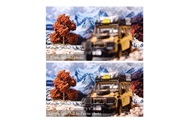
According to Korrespondent.net: Researchers at Carnegie Mellon University (Pennsylvania, USA) have introduced a new experimental camera that can simultaneously focus on all objects in a scene, regardless of their distance. This discovery, as reported by The Verge, could significantly change the way cameras operate, as traditional lenses allow clear shots of only one focal plane, blurring the background or foreground.
Autofocus Technology
The basis of the new technology is a 'spatially-varying autofocus' system. It combines several approaches and allows the camera to independently determine which parts of the image should be sharp. According to associate professor Matthew O'Toole, it looks as if each pixel has its own microlens with the ability to adjust focus separately.
Photo: Carnegie Mellon UniversityComparison of the photo and operating methods of a standard camera and the new experimental oneComputational Lens
A key component is the 'computational lens', which combines a Loman lens — a pair of curved cubic lenses that shift relative to each other to change the focus — and a phase spatial light modulator. This module controls the refraction of light at the level of individual pixels, allowing focus on several depths simultaneously. Additionally, the system employs two autofocus methods: contrast, which optimizes sharpness in different parts of the frame, and phase, which determines the direction of focus correction.
The Future of Technology
Professor Ashwin Sankaranarayanan noted that such a camera could radically change our understanding of how optical systems 'see' the world. However, this development currently remains experimental and is not yet used in commercial cameras. Whether it will appear on the consumer market is still unknown.
Researchers believe that the potential of this technology extends beyond photography. It could be useful for improving the operation of microscopes, creating a more realistic perception of depth in VR devices, as well as for autonomous control systems that require clear visualization of the environment.
Read also
- Antique Musket Balls Repurposed Into Solar Cells with 94% Efficiency
- South Korea Patents a Silent Engine for Air Taxis
- 144 FPS at 4K: A Gamer Pairs an RTX 3090 and RTX 3050 for Stunning Performance
- Snapdragon 8 Elite Gen 5: Qualcomm’s New Chip Targets Sub-$600 Smartphones
- Samsung Unveils Three New Odyssey Gaming Monitors: Specs and Features Revealed
- Plastic Waste Converted into Jet Fuel: New Breakthrough by Chinese Researchers