The war in Ukraine will last until 2026: Chatham House experts predict.

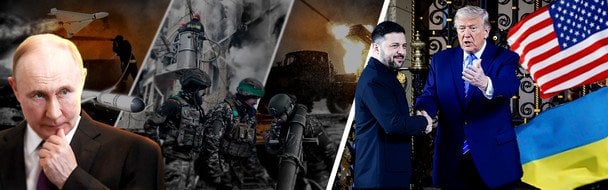
According to ТСН: It is quite likely that the war in Ukraine will continue into 2026. This is confirmed by promises of a quick peace that experts believe amount to "blind optimism and desperate hope" from U.S. President Donald Trump.
Russia will continue its actions
Specialist Kir Giles believes that Russia will not stop and will try to achieve its goals diplomatically, using Trump as one of its key tools. In 2025, he attempted to persuade Ukraine to meet Russia's conditions as part of a ceasefire agreement.
"Each time, the worst danger was avoided after transatlantic diplomatic struggles, as European leaders threw everything in to try to partially mitigate the damage. It may seem like a repetitive cycle, but each time Russia improves its position," he says.
Giles emphasizes that Russian troops continue to advance on the front, while Putin and Trump are trying to change the conditions that Ukraine and Europe must accept. The Russian "28-point plan," proposed in November, is now seen as a basis for negotiations.
"Meanwhile, the hostilities in Ukraine have been organized for months, and in some cases years prior. Russia continues to destroy Ukraine's defenses at the front, inflicting enormous casualties and attacking Ukrainian civilians every night with drones and rockets targeting cities with critical infrastructure. But the fact remains that the war will not be resolved on the front, and likely not in Ukraine," the analyst stresses.
International situation
According to Giles, the conflict will continue since neither coalition — the one supporting Ukraine nor the one backing Russia — is willing to intervene decisively. Countries like China, Iran, and North Korea are trying to maintain a balance between the benefits of exhausting Russia and its Western opponents, and the risks that may arise from increased support for Moscow.
"Among Ukraine's supporters, the reduction of U.S. support was quite predictable, as was the limited capacity of European states to compensate for this shortfall, given that they were not prepared for it in previous years," he explains.
European countries are also unprepared for the potential 2027, when the U.S. may reduce or completely cease support for European defense due to their indecisiveness in investing in their security system.
"The new U.S. national security strategy outlines a possible future distribution of American forces around the world. If implemented, not only will America's European allies face hostile regional heavyweights without U.S. security guarantees, but those living in East Asia will as well," Giles predicts.
The expert draws attention to the fact that in his book "Who Will Protect Europe," he described potential consequences, including conflicts between autocracies — Russia, China, and the United States.
"But if the ambitions of Russia and China remain unchecked, the new political geography that arises from this will be easily recognizable to anyone who has read '1984' by George Orwell," notes the consultant.
In conclusion, the expert notes that for now, American troops remain in Europe and integrated into the continent's defense structures, including NATO, fulfilling their duties until the Trump administration may change its position.
Undoubtedly, the unpredictability of the White House has significant influence: on one hand, it pushes European leaders to invest in their own defense, while on the other, it still restrains the Kremlin from open escalation.
"There is no doubt that Russia will not take any action against a NATO country until it is certain that the United States will not take any retaliatory measures. And so far, the unpredictability of the Trump White House has not given the Kremlin that confidence," Giles states.
The expert also emphasizes that Europe's inability to free itself from deep defense dependence on the U.S. leads to cautious behavior by European leaders in relations with the Trump administration, particularly evident in 2025.
"For Ukraine and its supporters, this means trying to pass off repeated diplomatic efforts as a 'peace process,' as well as clinging to the illusion that U.S. security guarantees against Russia will have any real value under the current administration," the analyst writes.
Giles also points to reports of achieved peace agreements. In his view, Trump and Zelensky might believe they are close to consensus, but that does not mean the war will end soon.
"They may be 90 percent of the way to an agreement between Ukraine and the United States, but at the same time — zero percent of the way to a viable agreement with Russia," Giles emphasizes.
The analyst stresses that ceasefire proposals, which Moscow has repeatedly rejected, indicate a simple calculation by the Kremlin.
"Russia believes it can get more by continuing the war than by agreeing to the gains offered by Trump," the expert notes.
The primary goals of the parties remain unchanged and incompatible: Russia seeks the liquidation of Ukraine as an independent state, while Ukraine fights for its existence. The absence of common ground between these positions led to the onset of the war in 2014 and its escalation in 2022. Even a potential ceasefire carries serious risks given Moscow's previous actions.
"Russia does not sign ceasefire agreements that it cannot break at a convenient time for itself," the analyst underlines.
Moreover, any decrease in hostilities could give European leaders an excuse to postpone necessary defense investments.
"Too many European capitals are still trying to pretend that the problem has disappeared and that there is no longer an urgent need for defense investments," Giles notes.
He also draws attention to the fact that Russia is already preparing for future actions in Europe through sabotage and reconnaissance attacks on critical infrastructure. These actions are termed "hybrid," as the alternative is to recognize them as military and finally make the political decisions that Europe has long avoided.
Giles notes that estimates of possible timelines for a new war vary, but all share a common trait: all scenarios occur before Europe is ready to defend itself.
"All of these scenarios happen before Europe is ready to defend itself," he summarizes.
He also emphasizes that even if active hostilities in Ukraine may cease, it does not mean that Russia's war against the West will end.
"As we approach 2026, despite all statements about inevitable 'peace,' there is no reason to believe that this reality has changed," Giles concludes.
The expert emphasizes that a real end to military operations in Ukraine can only occur under the condition of a change in power in the Russian Federation.
"Until there is a change in power, there will be no cessation of hostilities," says Oleg Zhadanov.
The war in Ukraine remains a critical factor not only for the region but for global security. The sanctions imposed, changes in international politics, and faith in the possibility of peace — all these will impact not only Ukraine's future but the future of the global community. Experts' predictions encourage reflections on the need for decisive actions to prevent a new escalation of the conflict and ensure stability in Europe and beyond.
Read also
- Canada Reaffirms Steadfast Support for Ukraine as Defense Minister Plans Meeting with Fedorov
- MAGA Influencer Admits to Falling for Russian Propaganda: What This Means for Trump’s Stance on Ukraine
- Rutte Praises Trump for Reviving Talks with Putin – What It Signals for Ukraine
- First Tankers Cross the Strait of Hormuz Following US-Iran Deal
- Zelensky Heads to Brussels for Key Ramstein Defense Meeting on June 18
- Zelenskyy Confirms Drone Strike on Moscow: Refinery Powering the Russian Capital Targeted