The Mystery of the Voynich Manuscript Unveiled: A Cipher with Playing Cards and Dice.

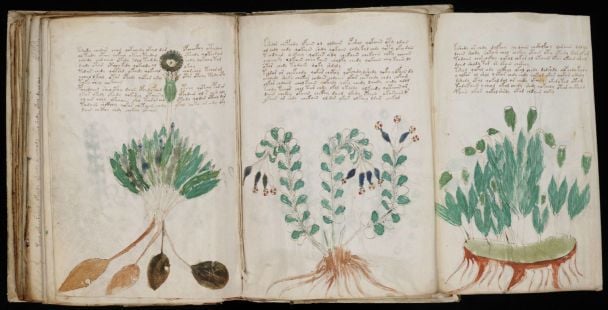
According to ТСН: Recent scientific research has shown that the mysterious Voynich manuscript may not actually be a text in an unknown language, but rather the result of complex coding. It discusses an original system that uses playing dice and cards to transform ordinary language into unknown hieroglyphs.
Scientists, relying on research data, found that this method creates symbols resembling the signs found in the Voynich manuscript. This gives reason to believe that such a cipher may have been used during its creation in the Middle Ages.
The "Naibbe" Method and Its Significance
The proposed method is named "Naibbe" in honor of the Italian card game from the 14th century. Although the cipher does not reveal the content of the manuscript, it offers a possible explanation of how this text was created.
The Voynich manuscript, dated to the 15th century according to radiocarbon analysis, contains about 38,000 "words" written in unknown signs. Despite more than a century of research, no scholar has yet been able to translate this text or reach a consensus on its origin. The manuscript impresses with its unusual illustrations of plants, astrological schemes, alchemical scenes, and images of naked women bathing in mysterious reservoirs.
The Mechanism of Cipher Creation
A study published in the journal Cryptologia describes a possible mechanism for the formation of the "Voynich" writing. As the author notes, an ordinary text in Italian or Latin was initially divided into individual letters and letter pairs using the roll of a dice. For example, the word "gatto" (cat) could be broken down into "g", "at", and "to".
Then, by using a randomly drawn playing card, it was determined which of several special tables to use for converting letters into unfamiliar glyphs. The frequency of use of these tables was adjusted to match the statistical structure of the Voynich manuscript text.
The author emphasizes that his model only partially reproduces the original manuscript, but it is one of the most convincing attempts to reveal the mechanism of its creation, not its content.
The manuscript is named after the antiquarian Wilfrid Voynich, who acquired it in 1912 from a Jesuit college near Rome. Currently, the manuscript is housed in the library of Yale University.
Despite numerous studies, scientists are still unsure whether there is a language on which the manuscript is written or if it is just a complex encryption system designed to confuse readers.
The research results, which challenge traditional views on the Voynich manuscript, may open new horizons in its study. Despite all efforts, the cipher remains unclear, so attempts to decipher this intriguing riddle continue, and perhaps over time we will receive more answers regarding its true content and purpose.
Read also
- Ukraine's National Police Uncovers $5.4 Million Military Medical Board Fraud Scheme, Raids 16 Regions
- Maine Salmon Farm Faces Scrutiny: Investigation Uncovers 133 Animal Welfare Violations
- Military Officials Inflated Generator Prices by 14%, Causing Over $295,000 in State Losses
- Defense Sector Corruption Exposed: Journalist Reveals Schemes Tied to Fire Point
- Up to 12 Years in Prison for Embezzling $300,000 in Generator Funds Meant for Ukraine’s Military
- Two Russian Commanders Identified in Odesa Missile Strike That Killed Eight Civilians