NASA Reveals the Secret: How Mars Transformed from a Blue Planet to a Red Desert.

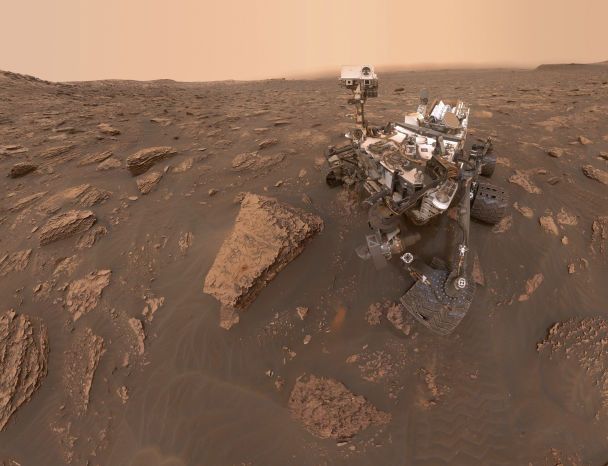
According to ТСН: NASA has presented new research findings that explain the evolution of Mars from a planet with water and a dense atmosphere to a cold desert. The MAVEN orbiter, which has been studying the atmosphere of the Red Planet for many years, has gathered key data.
Scientists note that in the past, Mars looked completely different. Its surface had liquid water, the atmosphere was much denser, and water vapor was actively spreading, giving the planet a 'bluer' appearance. Orbital images and geological data, including ancient river valleys, lakes, and a vast canyon system, suggest that without prolonged water activity, such formations would have been impossible.
Research and Discoveries
The research was led by planetary physicist Shannon Curry. Her team studied how solar wind and radiation gradually destroyed Mars's atmosphere after the loss of its global magnetic field. Scientists believe this occurred over 4 billion years ago, after which the upper layers of the atmosphere were left unprotected from solar particles.
Researchers focused on the phenomenon of atmospheric sputtering, where heavy ions from the solar wind impact atmospheric atoms, blasting them into space. MAVEN captured this process for the first time, particularly through measurements of argon in the Martian atmosphere, confirming a hypothesis that was previously based only on isotopic analysis.
The spacecraft also detected an active leak of hydrogen formed during the breakdown of water molecules in the atmosphere. The intensity of this process varies seasonally and sharply increases during dust storms. The loss of hydrogen is now considered the main factor in the disappearance of water remnants on Mars.
Surface Data and Geological Changes
Surface studies corroborate these results. The Curiosity rover in Gale Crater found sedimentary rocks that indicate the existence of a long-lasting lake with conditions suitable for microbial life. Meanwhile, Perseverance is exploring an ancient delta in Jezero Crater where a river once flowed. These deltas are crucial for the search for traces of ancient life due to their ability to preserve organic molecules.
Geologists interpret deposits in craters as evidence of repeated climatic cycles that help understand the stages of the planet's gradual drying.
By combining data about current atmospheric loss rates with a more active solar wind from young Sun, scientists concluded that Mars lost a significant portion of its primordial atmosphere, which in turn led to a drop in atmospheric pressure to the level where liquid water could no longer be retained on the surface.
Current State of Mars's Atmosphere
Today, Mars's atmosphere is extremely thin, composed mainly of carbon dioxide with traces of nitrogen, argon, and oxygen. This affects the reddish hue of the sky and the surface's vulnerability to cosmic radiation. Mars no longer has a global magnetic field, and only a few patches of the crust have retained magnetization as a faint echo of its active past.
'The results of the MAVEN mission connect subtle processes in the upper layers of the atmosphere with large-scale climate changes, the traces of which can be seen in Martian valleys, lakes, and dried riverbeds. This slow but steady loss of atmosphere has been key to understanding how the once watery Mars turned into the planet we see today,' says Shannon Curry.
It should be noted that recently one of the Starlink satellites from SpaceX suffered a severe malfunction in orbit.
The results obtained from the MAVEN mission highlight the importance of understanding the evolution of Mars's atmosphere to assess the potential for life on the planet. Studying Mars remains a priority for researchers, as it may provide new insights into both our Solar System and the chances of discovering life beyond Earth.
Read also
- Ukraine Aims to Cut Off Crimea and Destroy Russian Targets with Drone Strikes
- NATO Allies Agree on Intelligence: Russia Could Attack the Alliance by 2029
- Romania Demands Self-Destruct Capability for Ukrainian Drones After Incident Near Constanța
- Drones Strip Russia’s ‘Novorossiya’ Highway of Strategic Value: Madar on Truck Restrictions
- Ukrainian Drones Stall Russian Army's Advance on Kupiansk Front: No Positions Lost
- IAEA Demands Iran Report on Uranium Stockpiles, Backed by U.S. and European Powers