The USA demands that China stop the pressure on Taiwan: What is happening in the Strait.

According to ТСН: The United States has begun the new diplomatic year with a call for a reduction of tensions in the Asia-Pacific region. On January 1, the State Department published its official position regarding the actions of the People's Liberation Army of China and the large-scale military exercises around Taiwan.
The official position of Washington
In a press release on the State Department's website, Deputy Spokesperson Thomas Pigott emphasized that China's military activity is escalating tensions without any basis.
"We call on Beijing to exercise restraint, to end military pressure on Taiwan, and instead to initiate substantial dialogue."
The United States has also reaffirmed its commitment to peace in the Taiwan Strait, emphasizing that it will counter any unilateral changes to the status quo, particularly through violence.
What provoked the US reaction
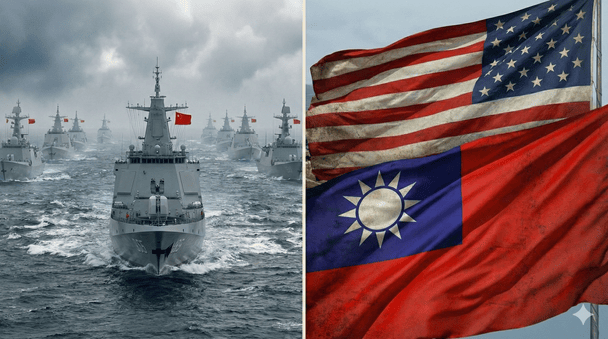
This statement was a response to the extensive exercises of the Chinese armed forces under the code 'Justice Mission 2025', which China unexpectedly began at the end of December.
As reported by The Guardian, the maneuvers involved simulating a complete blockade of major Taiwanese ports and conducting attacks on maritime targets.
The Taiwanese Ministry of Defense recorded a record level of activity: over 130 Chinese aircraft and 14 military ships were spotted in the air defense identification zone. This is one of the largest violations in recent years, as noted by The War Zone. Most of the aircraft crossed the so-called 'median line' of the Strait, which has long served as an unofficial boundary.
The 'Grey Zone' tactic
Experts point out that China is increasingly employing the 'Grey Zone Warfare' tactic - aggressive actions that are on the brink of open conflict but do not formally constitute war.
According to data from the Global Taiwan Institute, Beijing is normalizing its military presence around Taiwan to exhaust the resources of the Taiwanese army and exert psychological pressure on the population. Regular exercises, cyberattacks, and disinformation have become part of daily life in the region.
The role of the USA
Although the United States has no official diplomatic relations with Taiwan, they remain the main guarantor of the island's security under the 'Taiwan Relations Act'.
This law obliges Washington to provide Taipei with means for self-defense and to support its ability to resist any form of violent coercion, according to the American Institute in Taiwan.
It is also worth noting that Chinese leader Xi Jinping reiterated threats against Taiwan during his New Year's address, viewing it as part of his sovereign territory. Beijing's rhetoric is becoming increasingly sharp, promising the 'inevitable reunification' of mainland China with Taiwan.
These events testify to a worsening of tensions in the region, where the interaction between China and Taiwan remains crucial for peace and stability in the Asia-Pacific region. The United States' position demonstrates its determination to support Taiwan under unfavorable conditions while China actively strengthens its military capabilities in this strategically important area.
Read also
- Trump Thanks Putin and Xi for Staying Neutral Toward the U.S. During the Iran War
- Trump Shifts Attention from Iran to Ukraine: What Lies Ahead for Kyiv After the Deal
- Is China Ready to Help End the War? Zelensky Signals Willingness to Meet Xi Jinping
- Xi Jinping Arrives in North Korea Marking 65 Years of Strategic Alliance
- Xi Jinping and Kim Jong Un Agree to Broader Cooperation: What It Means
- The Global Survival Game: Trump, Xi, and Putin in the Geopolitical Vortex