The Munich Security Conference will not invite Russia in 2026: the reason named.

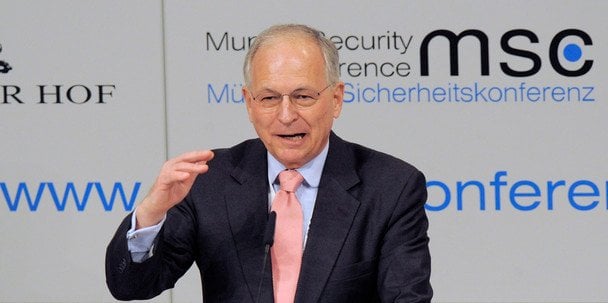
According to ТСН: Wolfgang Ischinger, acting head of the Munich Security Conference, believes that direct negotiations between European countries and the Russian government make no sense right now.
Ischinger noted that Russian politicians have made it clear more than once that they see Europeans only as 'vassals of the United States' and intend to primarily engage in dialogue with Washington.
These reasons, according to Ischinger, led to the decision not to invite Russian representatives to the Munich Security Conference, which will take place in February 2026.
He also added that even if Russian officials decided to come, they would probably be 'booed by 90 percent of the other conference participants.'
“I am sorry, but currently the presence of a Russian government representative at the conference makes little sense,” he emphasized.
Ischinger also skeptically evaluated the proposal of French President Emmanuel Macron for direct negotiations with Kremlin head Vladimir Putin.
At the same time, he expressed hope that in the future there would be an opportunity for serious negotiations between Germany, European countries, and the Russian side, which would allow the return of Russian representatives to the conference.
“But, unfortunately, we are not at that stage yet,” Ischinger noted.
He also shared that he tried this year to find Russian representatives for the conference with 'serious intellectual, political, or military experience' who were not 'classical oppositionists,' but did not find such candidates.
Ischinger emphasized that the Iranian Foreign Minister Abbas Araqchi was invited to the forum, although confirmation of his participation has not yet been received.
Moreover, he believes that the German government, considering Russia's aggressive war against Ukraine, should provide additional armament to Poland.
“This partner in the EU and NATO is currently something like a frontline state,” he noted.
Ischinger believes that Germany could provide military assistance to Poland free of charge to strengthen its defense capability. He noted that this would involve 'a submarine, a frigate, or perhaps some military equipment,' adding that such a step would require budget expenditures from the FRG but would be 'incredibly good investment in terms of political wisdom.'
It was previously reported that US President Donald Trump was willing to take on the commitment regarding US involvement in the defense of Ukraine provided that Russia does not attempt to attack again.
It is also said that Ukraine was promised strong security guarantees in the event of a new strike from Russia.
Ischinger's position underscores the complex geopolitical situation in Europe, where direct negotiations with Russia cannot occur due to the Kremlin's aggressive policies. For now, the international community is focused on strengthening security in the region and finding new approaches to managing international relations.
Read also
- At the G7, Trump Proposed Backing Ukraine in Exchange for Iran Cooperation
- G7 Leaders Adopt Joint Declaration on Ukraine: New Air Defense Systems and Tougher Sanctions
- At the G7 Summit in Évian, Trump Acknowledged Putin’s Reluctance for Peace in Ukraine
- Iran Truce Deal Signed by Trump: What the Memorandum Entails
- First Tankers Cross the Strait of Hormuz Following US-Iran Deal
- Strengthening Ukraine's Air Defense: Zelenskyy and NATO Chief Rutte Hold Talks in Brussels