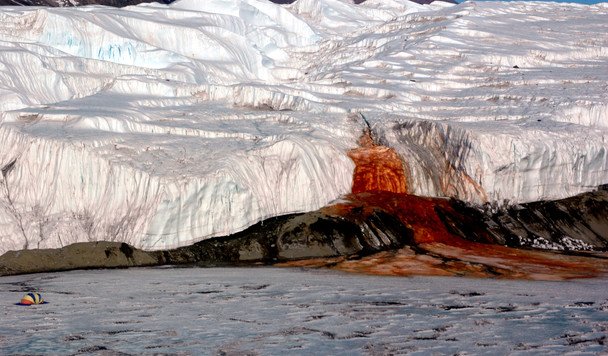
Antarctica's Blood Falls Mystery Solved: Sinking Glacier Releases Red Water.

The Mechanism Behind the Rusty Red Discharges
According to TSN.ua: Scientists have uncovered the process behind the sudden, rust-colored water discharges at Antarctica's Blood Falls, linking them to the subsidence of the Taylor Glacier. These discharges occur in the McMurdo Dry Valleys, where this natural phenomenon was first documented as far back as 1911. The Dry Valleys are one of the most extreme deserts on Earth, making this feature uniquely alien.
In September 2018, a tracker recorded the surface of the Taylor Glacier sinking by 1.5 centimeters. This subsidence acted as a catalyst for the release of the red stream, which serves as a vivid indicator of activity within subglacial reservoirs. The water temperature in a lake 18 meters deep cooled to 1.5 °C, further signaling shifts in the region's ecosystem.
Implications and Significance of the Research
According to research, the brine reservoir from which these discharges originate has been isolated under the ice for between three and five million years. Blood Falls can be viewed as a natural pressure-release valve, activated by changes within the glacial structure. Geologist Peter T. Doran from Louisiana State University (LSU) notes:
“These processes could have serious implications for understanding global climate change and its impact on Antarctic glaciers.” - Peter T. Doran
Thus, the studied discharges of rusty-red water are a crucial element for further research into glacial dynamics and potential ecological changes in the region.
This research underscores the importance of monitoring glacial processes within the context of global warming. Understanding the mechanisms leading to the discharges could aid in predicting future changes in Antarctic ecosystems, which, in turn, has significant consequences for the global climate. Consequently, the study of Blood Falls not only expands our knowledge of the region's specifics but also highlights the necessity of a comprehensive approach to studying the impacts of climate change.
Read also
- Moscow Redirects Ukrainian Drones; Kyiv Pitches 'Drone Deal' to Shield Europe
- Investigation Concluded After Russian IL-18 Violates Finnish Airspace
- Iran Hit by US Strikes After Apache Helicopter Downed
- Ukrainian Forces Strike Ammunition Depots in Russia’s Belgorod Region: Inside the Successful Operation
- Finland Concludes Border Breach Probe: Russian IL-18 Jet Entered Its Airspace
- Ukrainian Forces Strike 36 Russian Targets: Moscow’s Daily Losses Revealed