NATO transformed by Ukraine conflict: countries that enlarged their armies and reintroduced mandatory service.

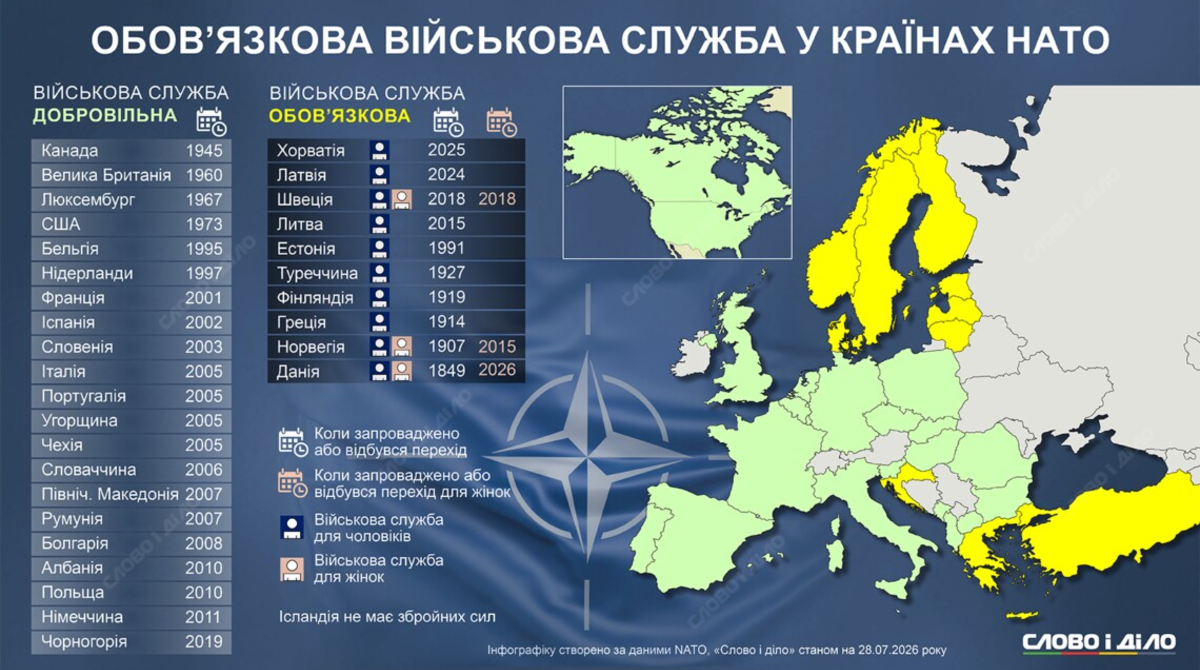
According to Слово і Діло — Інфографіка: The Russian invasion of Ukraine in February 2022 triggered a major reassessment of defense policies across NATO, leading to both troop expansions and changes in conscription practices. This article examines the shifts in military service and army sizes among alliance members between 2021 and 2026.
NATO member states' military service reforms from 2021 to 2026
Between 2021 and 2026, significant changes have occurred in how NATO nations handle conscription and voluntary military service. The war in Ukraine, which began on February 24, 2022, acted as a catalyst for many alliance members, leading to adjustments in army sizes and defense strategies. As of 2026, NATO comprises 32 countries, and 21 of them do not have mandatory military service.
Among NATO members without conscription:
- Iceland, which has no formal armed forces;
- Canada, which ended conscription in 1945;
- The United Kingdom and Luxembourg, which eliminated mandatory service in the 1960s;
- The United States, which abolished the draft in 1973;
- Belgium in 1995;
- the Netherlands in 1997;
- France and Spain in 2001;
- other countries including Poland, Germany, and Montenegro.
As of 2026, only 10 NATO countries maintain compulsory military service.
How the conflict in Ukraine affected troop numbers across NATO
Significant shifts in army strength among NATO members occurred after Russia's invasion of Ukraine. Poland's military grew by 58% – from 167,000 in 2021 to 263,000 in 2026. Lithuania's army increased by 33%, Latvia's by 28%, and Sweden's by 27%. Meanwhile, the U.S. military shrank by 27,000 personnel, reaching 1,322,000 in 2026. Germany's Bundeswehr stayed relatively stable at 183,200, while France's army decreased by 2.7% from 207,600 to 202,000.
Regarding changes in service policies, Sweden reinstated conscription in 2018, and Norway brought it back in 2015. Greece, Finland, and Turkey have had mandatory service since the early 20th century. Estonia, Lithuania, Latvia, Croatia, and others introduced compulsory service at various points beginning in 1991.
Overall, the analysis of NATO countries' military service trends from 2021 to 2026 shows a clear shift toward voluntary service in most nations. At the same time, a number of countries have significantly expanded their forces, reflecting efforts to bolster defense capabilities amid new threats.
The evolution of NATO countries' military service models reflects the alliance's adaptation to modern security challenges arising from Russia's aggression in Ukraine. The growth in army sizes across Eastern Europe likely indicates a drive to strengthen defensive readiness against potential threats. Meanwhile, the trend toward voluntary service elsewhere suggests shifting attitudes about military service in the context of new global security realities.
Read also
- Four enemy armored vehicles destroyed in Zaporizhzhia as MiG-29 pilot executes precision bombing attack
- Six times cheaper than Tomahawk: Flamingo missile punches through Russian factory roof
- Ukrainian Forces Hit Russian Depots and the 'Priority' Plant in Fresh Attacks
- Three Russian Drones Downed Over Romania Put Ukraine's Grain Exports at Risk
- Russian Forces Breach Border in Kharkiv Region: Analyst Zyrokhov Identifies Critical Frontlines
- Russian National Guard Commanders Sentenced to 12 Years Each for Assault on Zaporizhzhia Nuclear Plant