The trend for unique names for children: what drives the desire to stand out.

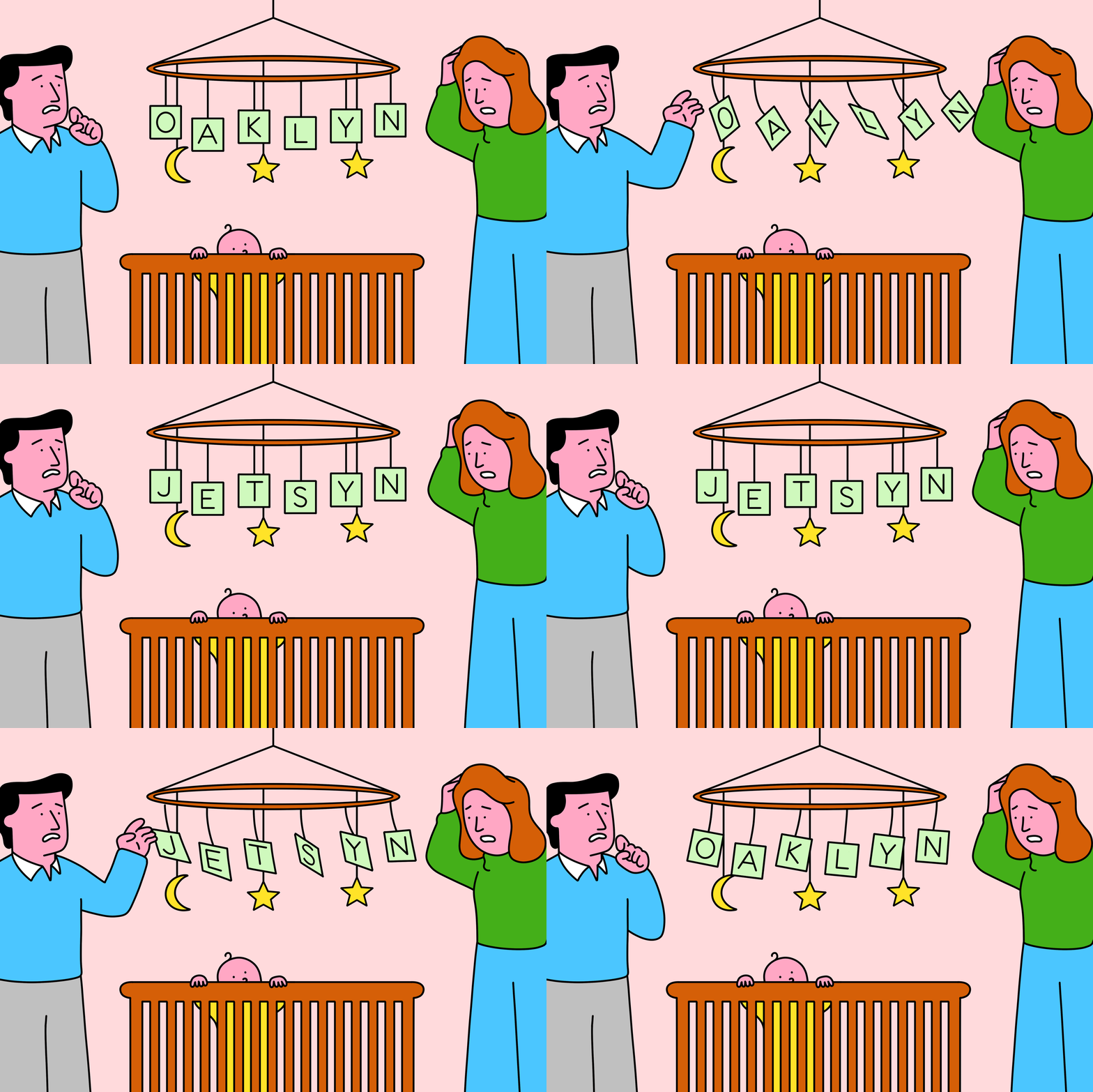
According to Vox: Before K-Anna Stevens posted her daughter’s name in the Facebook group ‘This Name is a Tragedy,’ she already suspected that the reaction would not be overly positive. After all, people on the internet often lack kindness, and the group, with more than 154,000 members, was created to mock ‘tragic names.’
Stevens knows how hard it is to carry an unusual name. She was named after her grandmother and distant relatives (Kay + Anna), and she has heard mispronunciations and remarks more than once, as well as faced difficulties when filling out forms on government websites. However, for almost 30 years, she has gotten used to it.
But even with such experience, K-Anna Stevens couldn’t imagine how cruel the internet would become when it came to her daughter’s name - Sadilyn.
“It’s Say-di-lin,” Stevens tells Vox about the pronunciation. “After the first 10 or 20 comments, I turned off comments and tried to forget about that post.”
Sadilyn, according to Stevens, emerged because she liked the name ‘Saidy,’ pronounced like Saidi Hawkins. One relative noted that his dog is named Saidy, which prompted Stevens to add -lyn, combining her first choice with another name she liked. In 2016, when Sadilyn was born, Stevens noticed a rise in the popularity of sounds -ay and -lyn in children’s names and decided to follow this trend.
When she posted the name Sadilyn in a Facebook group — it’s worth noting that there is a similar community on Reddit called r/Tragedeigh, which has 764,000 users each week — she was seeking constructive feedback. But instead, she received a torrent of insults regarding her education, mental health, financial status, employment, and lack of compassion for her daughter.
“How would I describe it in words? Something like, Oh God, she’s one of those people. Was she on drugs during her pregnancy? What was going through her head?,” Stevens tells. “These comments literally swirl in my head.”
Names with alternative spellings are indeed a strange trend that is hard to track, as uniqueness is a key factor. However, this phenomenon inspires both followers and hatred, often entering the public consciousness through ridicule. Why do people strive to create such ‘one in a billion’ names? Why do they provoke so much aggression capable of sustaining numerous internet forums with large numbers of participants? And what do these names mean for the children who carry them?
As with many things we dislike, our dislike says more about us than about any child with the name Sadilyn.
Jetsyn? That’s a beautiful name for a girl!
According to name experts and linguists, changing the spelling – adding Y or features like -lyn or -ay to an already existing name – is part of a trend known as ‘alternatively spelled’ or ‘uniquely spelled’ names, often referred to as ‘Utah mom names.’
“Utah is a sort of early warning system for what will become popular,” Cleveland Evans, a professor and former president of the American Name Society, told NPR earlier this year, speaking about the rise of names like Oaklyn, Oaklee, Oakleigh, and their variants. Perhaps the most famous example of the ‘Utah mom’ style is “Mom on the Board,” the Philadelphia resident McKinley Hatch, who went viral for her list of names like “McCarty” and “Navy.” (She chose “Lakynn.”)
But these naming phenomena are not exclusively characteristic of Utahns.
In July, the Toronto Blue Jays honored pitcher Jeff Hoffman, who was born in New York, by giving away a figurine of him. During the first pitch, he was accompanied by his sons Titan and Houston, as well as his daughters Jetsyn and Linnin.
A famous Jessica!
| Dimitrios Kambouris/Getty Images
According to Colin Slagen, a name consultant, this is not a completely new concept - the desire to deliberately alter the traditional spelling of a name. Slagen notes that variations in names started with the Puritans, the first Americans. This tradition goes back even further to William Shakespeare, who, Slagen believes, invented the name Jessica – the 775th most popular girl’s name in 2025, according to Babycenter. Some scholars believe Shakespeare anglicized the name from the original Hebrew name ‘Jesca.’
Just as we perceive Oaklee today, so did Shakespeare’s contemporaries view Jessica back in 1598. Perhaps we would view Oaklee differently if plays, poets, and pilgrims were the ones trying these names out instead of the people we see on Instagram.
“Nowadays, this style - deliberately changing the traditional spelling of a name - is popularized through social media and influencers,” Slagen says. Familiarity leads to similarity. For those who admire the aesthetics of influencers and see their lives as worthy of imitation, choosing a child’s name is just one facet of their life that can be admired and perhaps copied.
Most names that people choose to ‘revive’ already exist, and their alternative spelling makes them new enough, without veering too far from the familiar. “It’s a way to choose a name that looks unique but doesn’t sound unique — for example, writing the name Peyton as Paytin,” Slagen notes.
The motivation for altering a name’s spelling may have deeper roots than simply a desire to stand out. Taylor Humphrey, a name consultant, explains that certain sounds and characteristics in names might be associated, for example, with femininity or masculinity. Changing the spelling of a traditional male name and introducing a feminine feature can disrupt the binary.
This change can give “daughters the strength of a masculine name while simultaneously clarifying that it’s a girl’s name,” Humphrey tells Vox. She explains that in the 1930s, names such as Dolores, Francesca, Florence, Beatrice, Gladys, which contained the masculine sound “s,” became increasingly popular. This sound is found in ancient names from Rome (e.g., Aurelius).
Humphrey developed this theory, noting that today more popular male names end with an “n” sound (such as Benjamin, Tristan, Hudson). If parents want a name that carries this feminine touch on a traditional male name, they need to find a way to introduce this “n” sound.
“I think that mothers-daughters are once again choosing this masculine strength and adding the ‘n’ ending to names that could end in a or y.” For example, Emmily becomes Emmersyn; Oakley, Oaklyn; and Trista, Trystan or Trystin.
We need to talk about Bradley
Whether it’s Sadilyn, Oakley, or Houston, these names tap into emotions. Jokes, insults, harmless accusations of “child cruelty,” concerns about potential bullying, and comparisons to characters from Game of Thrones by George R.R. Martin become commonplace. Why so much outrage?
Although these names are still too new for in-depth research, existing studies on how the public perceives unique names are not encouraging. This may explain why people react so negatively.
Even despite name changes, the police status remained.
Research again shows that people tend to evaluate others more positively and trust them if they have understandable and familiar names (this discriminates against immigrants and people of color). It seems that Americans are more inclined to trust doctors and accountants with names like Pete and Laura than they are to trust their taxes and health to Houstins and Everlys.
People love what they know and often seem reluctant to embrace the novelty of others.
“English does not always have consistent spelling rules,” Humphrey states. “When parents add -ay or replace with y, it can appear to be a violation of the social contract of ‘how names should be spelled in relation to general norms.’”
Ashley Zosel-Harper has faced this challenge her whole life. She says she is asked about once a month why she spells her name with an -ay and not Ashley. This is a question, she says, her parents could have answered better.
Part of the interest, nevertheless, may specifically relate to Zosel-Harper’s millennial age. In the late 80s, the name ‘Ashley’ surged in popularity, becoming the most common variant. “Ashley” saw a minor spike in popularity in the early ‘90s, shortly after the boom for “Ashley” — perhaps reflecting how unique spellings become a response to the growing popularity of an existing name.
Zosel-Harper points out that the questions and suspicion that “Ashley” is the more correct spelling never particularly bothered her. “I think it made me feel less typical Ashley,” Zosel-Harper says. “I didn’t quite fit that stereotype, so it gave me a feeling of independence from my name.”
But she also notes that she never particularly ‘liked’ that name (extra letters, in her opinion, feel ‘a bit of a hassle’). There were so many Ashleys that it didn’t feel unique. It was nothing compared to her high school classmate, Bradley.
“Bradley, but spelled B-R-A-D-L-E-Y? That absolutely threw me for a loop,” Zosel-Harper shares.
Why some people find it hard to see Oaklee winning
Sometimes the reaction is more than just jovial curiosity.
Humphrey explains that part of the negative response to these names is rooted in classism. She quoted an article from The Cut in 2022 that examined negative reactions to names like Loyal, Ozzy, Amberly, theorizing that it relates to the association of these names with poverty or lack of education, or to a person who is poor and uneducated and unaware that a name can convey all these things.
Even despite name changes, the police status remained.
Recently, there has been a growing obsession with the aesthetics of “old money” and “quiet luxury.” It’s the idea of elegant consumption that only true wealthy can access. This refined consumer style manifests in accessories, clothing, cars, hair colors, schools, home goods, and even names. (Names considered “old money,” like Amelia, Charlotte, Olivia, and Emma, rank among the top ten girls’ names for 2024, while Theodore, James, Henry, and William rank among the top ten boys’ names).
Among these seemingly vast and diverse aspects and identifiers lies restraint and tradition. Only those who understand the silence of luxury can perceive it, and no one who cannot is regarded as an outsider.
Names like Titan, Oakley, Jetsyn, and Lennin may seem like outsiders. They are bright, attention-grabbing, and meant to be noticed. They threaten tradition. Parents, like Stevens, know how these names are supposed to look but choose them in defiance of the rules.
“Sara, Hannah, Emily — they are beautiful names, but I don’t know, that’s just not for me,” Stevens says. Despite internet speculation, Stevens claims she didn’t actually receive significant negativity about the name Sadilyn in real life, apart from instances when she asked teachers and instructors not to shorten it to Saidi.
“I never intended to try to make Sadilyn special,” she says. The name “just brought me a lot of joy.”
Why the futures of Lakynn and Houston seem unlikely
Humphrey pointed out that names each given to fewer than 25 girls in 2024, such as Trystin (24), Lakynn (16), and Houston (5). Oaklinn, possibly one of the most popular of these “Utah mom names,” was given to 1,898 infants. Given that there were 3.6 million births in the US, the idea that these names may become extremely popular appears somewhat exaggerated.
It may be more useful to consider the rise of these names and their reactions as part of a larger trend of Americans trying to navigate identity and tradition. Choosing a unique spelling of a name is a way for parents to signal their individuality. They are also a means for parents to shift perceptions of gender (for example, giving girls names that sound masculine but are spelled with feminine features). These trends seem to look more enduring than the names people choose.
If you have concerns about the increasing spellings like -y, -leigh, and -lynn, perhaps, there is light at the end of the tunnel.
Every year, the most popular names actually become less popular.
“Here’s the thing: every year, the most popular names actually become less popular,” Humphrey says.
Essentially, the number of people naming their children the most popular names is decreasing. Today’s most common names do not dominate the way Michaels, Jessicas, and Sarahs did decades ago. Americans still have their favorites, like Liam and Olivia — the most popular names in 2024 — but they aren’t as oversaturated.
“Parents naturally broaden their preferences among a wider array of options, which may ultimately resolve the need for creative spellings,” Humphrey states.
And perhaps — perhaps — that won’t happen.
Read also
- Three Ukrainians Without Documents Rescued from Occupied Territories Under Bring Kids Back UA Initiative
- Ukraine’s first underground kindergarten opens in Kharkiv, accommodating 260 children
- Ukraine's ports crippled by Russian strikes: 28 vessels hit, 21 killed
- 24 Children Rescued from Occupied Territories by Save Ukraine, Including Injured 13-Year-Old Anhelina
- Woman Faces Up to 7.5 Years in Prison After Attacking Children for Speaking Ukrainian in Poland
- One of the Most Recognizable Voices on Ukrainian Radio, Journalist Oleksandr, Has Passed Away