The Mystery of Moai Unveiled: Who Really Built the Giant Statues.

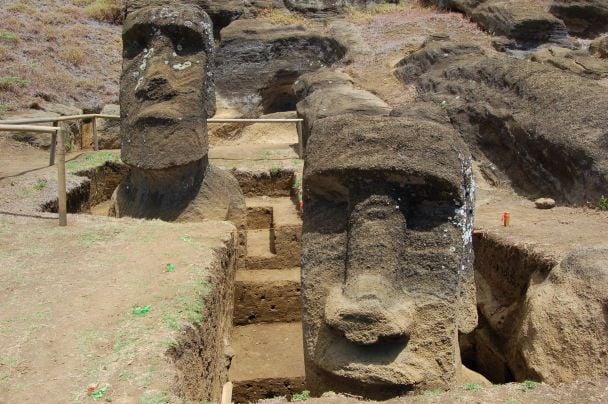
According to ТСН: The mystery of Easter Island has received a new explanation: archaeologists have discovered that the giant Moai statues were created not by a centralized authority, but by small clans or families.
Research has shown that there was no need for hundreds of organized workers to create and move the 12-80 ton statues. New archaeological findings, obtained through modern technologies, disprove this theory.
Workshop Research
Using a new 3D model of the main quarry on Easter Island, archaeologists have identified 30 different "workshops" where the statues were made. Professor Carl Lipo, one of the study's authors, notes:
“We see separate workshops that actually correspond to different clan groups intensively working in their specific areas.”
Each clan had its unique artistic style and specialized methods, as well as its own preferences for quarry sites. For example, some Moai had a distinctly feminine appearance, indicating an individual approach by small groups.
Moving the Statues
New findings confirm that significantly fewer resources were required to produce and transport Moai than previously thought. It turned out that to carve one statue, only four to six carvers and an additional 10-20 family members for support and tool making were needed.
A sensational discovery explained how the statues were moved. Instead of dragging them, as previously believed, the people of Rapa Nui used ropes to sway the Moai and induce a "walking" motion. Experiments showed that 18 people could control the sculpture, exerting minimal effort once the swaying began.
Special "Moai roads" were built for transporting the statues, the shape of which helped maintain the statue's stability during movement. This ultimately proves that Easter Island was not politically homogenous, and the production of Moai occurred within small family groups.
The study also emphasizes that Polynesian rats played a key role in the disappearance of palm trees on Easter Island, destroying nearly all the seeds. This calls into question the theory that logging was primarily caused by humans. Scientists note that after the Polynesians arrived around 1200, the rat population, devoid of natural enemies, grew to millions, leading to the destruction of 95% of seeds and the inability to restore palm trees.
These discoveries change the understanding of Easter Island culture, indicating that the creation of Moai was not the work of a centralized elite but of ordinary residents collaborating within their communities. The study of the impact of rats on the ecosystem also underscores the importance of the balance between humans and nature, which remains relevant in the modern world.
Read also
- Suitcase delivery to parcel lockers across 8 EU countries launched by InPost – pricing revealed
- Bus Service to Poland via Shehyni Checkpoint to Halt for 18 Months Starting June 15, 2026
- Over 10 Odesa Beach Zones Certified and Ready for Summer Season
- Anticipating Summer Ticket Surge, Ukrainian Railways Shares Booking Tips
- Europe's Airports Face Six-Hour Queues: IATA Warns of New Crisis
- Malmo to Narvik by Night Train: Snälltåget Launches New Service with Fares and Schedule