The new Russian missile 'Oreshnik': why the Soviet prototype lost to the USA in accuracy.

According to ТСН: The modern Russian missile 'Oreshnik' is the result of Soviet developments from the 1980s, which were unable to compete with American technologies. Analyst Oleksiy Yizhak explained why the power of the USSR could not match the accuracy of the USA.
Historical context
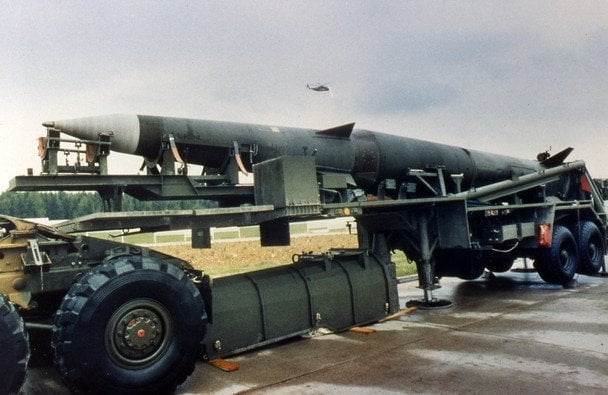
The technical predecessor of the Oreshnik medium-range ballistic missile is the Soviet RSD-10 Pioneer. In the 1980s, it lost the strategic competition to the American missile Pershing II, which proved to be more effective due to its accuracy, even despite the fact that the Pioneer had better formal characteristics, such as longer range and heavier warhead.
The Soviet leadership acknowledged a certain parity in the combat capabilities of both missiles, leading to an agreement to eliminate medium-range missiles — this was one of the steps towards the decline of the USSR.
Missile characteristics
RSD-10 Pioneer had a launch mass of about 37 tons, of which approximately 26.6 tons was the first stage and 8.5 tons was the second. The range of destruction varied from 600 to 5000 km, with an accuracy of 550 meters at circular probable deviation. In the version with a single warhead, the power reached 1 megaton, while in the multiple warhead version — 150 kilotons for each block.
Pershing II was significantly more compact: launch mass — 7.49 tons, which is less than even the mass of the second stage of the Pioneer. The maximum range was 1770 km, and the accuracy was only 30 meters. The yield of its nuclear warhead was equal to 80 kilotons, and the mass was about 270 kg.
Despite its smaller size, Pershing II turned out to be much more effective in combat conditions. The key factor was the physics of the explosion, where the accuracy of detonation and approach to the target mattered more than the charge itself.
Conclusions
Estimates of the destructive capability of missiles show that RSD-10 Pioneer had a rating of 0.13 conditional units, while Pershing II — 0.79. This confirms that the American missile had a higher probability of destroying well-protected targets, including important command points.
It is also worth noting that the analysis of the debris of the Oreshnik used by Russia in the attack on Dnipro revealed production parts from 2017, which refutes claims of 'new development'. Experts also identified this weapon as an old model R-26 Rubizh, the development of which began in the early 2010s.
Additionally, the self-proclaimed president of Belarus Alexander Lukashenko noted that Russia had the opportunity to strike with the Oreshnik missile at the residence of Ukrainian President Volodymyr Zelensky, but Putin rejected proposals to attack decision-making centers.
Thus, modern Russian developments such as the Oreshnik missile demonstrate how the technical legacy of Soviet times influences the military capabilities of the country. Despite significant resources and efforts being spent on updating arsenals, the results, as seen from the comparison with American technologies, still leave room for improvement. These factors may become crucial in future conflicts and defense strategies being pursued in the region.
Read also
- Over 500 Belarusian Firms Supply Weapons to Russia, Fueling Lukashenko’s War Profits
- Kremlin’s Nuclear Blackmail Against Europe: Russia’s ‘Oreshnik’ Deployment in Belarus
- Belarus Transformed into a Russian Military Launchpad for a New Offensive
- Belarus Leader Warns Armenia Against 'Ukrainian Scenario' Ahead of June Elections
- Armenia Warned by Lukashenko Against Leaving the EAEU: Potential Consequences Ahead
- Belarus Leader Warns Ukraine of a 'Different Kind of War' if Belarus Is Attacked