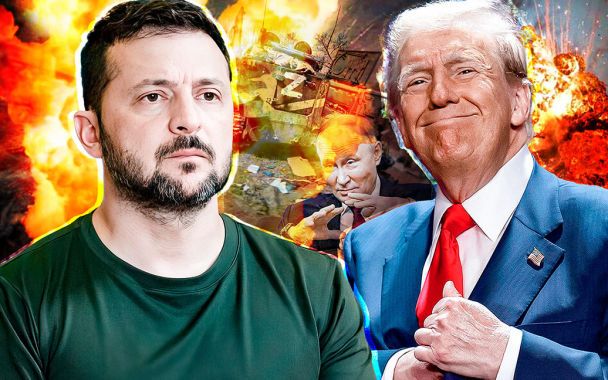
Zelensky handed Trump a peace plan: Ukraine may agree to a demilitarized zone.

According to ТСН: Ukraine is ready to discuss a difficult territorial concession, including the creation of a demilitarized zone in Donbas as part of a new peace plan. Advisor to the President's Office Head Mykhailo Podolyak noted that this zone would require the withdrawal of forces from both sides of the front and control by international missions, including from the United States. However, there is no final agreement from Kyiv yet.
According to the report, Kyiv has agreed on a key point in the negotiations with the US and Russia — the creation of a demilitarized zone in Donbas. This decision has received support in Europe, where it is seen as a way to end nearly four years of war. This concession has been included in the US peace plan, refined by Ukrainian President Volodymyr Zelensky and handed over to American President Donald Trump. The document has also received support from French President Emmanuel Macron, British Prime Minister Keir Starmer, and German Chancellor Friedrich Merz.
Conditions of the Demilitarized Zone
Kyiv believes that the creation of a demilitarized zone will force Ukrainian and Russian forces to retreat from the current front line in Donbas. The region may come under the control of international missions, including the US, which should prevent new acts of aggression from Russia.
"The demilitarized zone must exist on both sides of the line. It is necessary to logically and legally determine whether all types of weapons should be withdrawn or just heavy ones. To avoid possible violations, it is necessary for representatives of monitoring missions and foreign contingents to ensure compliance with agreements. (...) This is a natural format for ending the conflict, as part of the territory, unfortunately, will remain under the de facto occupation of Russia, and the line of demarcation will still be established," Podolyak explained.
Control over Compliance with Agreements
"It is necessary to clearly define the volumes and missions assigned to the third party," noted the advisor to the head of the OP, emphasizing that Kyiv would ideally like to see the US within the monitoring force to ensure compliance with the agreements, monitoring, and the absence of unauthorized troop movements.
This approach resembles the demilitarized zone between North and South Korea, established in 1953. The Korean DMZ is 4 km wide and 250 km long. The Ukrainian variant will likely be significantly larger.
As noted, for Zelensky, such a territorial concession is extremely painful, but it allows avoiding the actual capitulation that Moscow has sought, particularly regarding the transfer of those parts of Donbas that remain under Ukraine's control. For the Ukrainian president, this is absolutely unacceptable, as the military and society categorically oppose any acts of "surrender."
Funding for Ukraine's Reconstruction
Podolyak explained that the document handed over to the United States consists of three sections.
The first — on the conditions for ending the war, outlined in about 20 points.
The second — on the formation of a new European security system after the war, including guarantees that would prevent future Russian offensives.
The third — on the reconstruction of Ukraine, its economy, and defense potential.
"The aggressor must participate in financing reconstruction — this is a mandatory condition for ending the war. Otherwise, the aggressor only benefits from the conflict and will have no deterrent factor," Podolyak emphasized.
President Zelensky's communications advisor Dmytro Lytvyn clarified that Le Monde inaccurately reported the statement made by the OP head's advisor, claiming that Ukraine has already agreed to the condition regarding the demilitarized zone.
"Mykhailo told them in general that various things could be discussed, but the question is always in the details, how it can work. Whether Ukraine has agreed or not can only be decided at the highest political level or by the people of Ukraine, as the president said to reporters yesterday," Lytvyn added.
"The concessions made by Zelensky are complex decisions. And the two sections — on security guarantees and reconstruction — are a kind of "consolation prizes" to ease perception," commented a European diplomat.
Currently, Zelensky has stated that the US proposes the creation of a "free economic and demilitarized zone" in the east of the country, allowing Russian troops to withdraw from parts of the northern regions but maintaining their presence in the south. As a result, Russian troops could leave Sumy, Kharkiv, and part of Dnipropetrovsk regions, but remain in Kherson and Zaporizhzhia.
To align positions, a meeting may take place in Paris on December 13 with representatives from the US, Germany, Great Britain, France, and Ukraine. Two days later, Merz proposes to hold a meeting already at the leader level in Berlin together with Trump. Whether he will come remains to be seen.
"Let’s see what the future holds for us," noted the US president, adding that he doesn’t want to "waste his time".
The American leader, contrary to historical facts, places the responsibility for the war on Ukraine, issuing an ultimatum to Kyiv by Christmas — a deadline that creates additional tension. However, according to Ukrainian MP Oleksandr Merezhko, “Zelensky does not succumb to American pressure”.
"If Trump abandons us, he will have the image of Chamberlain — the "guilty" one who signed the Munich agreements," the MP noted.
Merezhko emphasizes that, despite all Ukraine's efforts, understanding with Russian President Vladimir Putin is impossible: "Ukrainians want to live, and Putin wants to kill us."
It should be noted that earlier Zelensky stated that proposals from the US for resolving the situation around Donetsk, which accommodate the Russian position, do not correspond to Ukraine's interests. The American side is modeling the creation of a "free economic zone" or a demilitarized area where Ukrainian troops withdraw and Russian ones do not enter. However, the question of control remains open. Zelensky emphasized the absence of the parity principle (the withdrawal of troops at a similar distance) and the risks of Russian advancement into this zone. He also stressed that control must be accompanied by international monitoring. The President emphasized that the decision on territorial compromises must be made by the people of Ukraine — through elections or a referendum, and diplomatic terms depend on the military's positions at the front.
It should be noted that Merz stated that in the peace proposals sent by Kyiv to the US, "first of all, it concerns what territorial concessions Ukraine is willing to make." The German Chancellor emphasized that this is a question that the Ukrainian president and people must answer, and it would be a mistake to force Kyiv into peace that its people will not accept.
All these events underscore the complexity and ambiguity of the situation in Donbas and the importance of international support for Ukraine. Upcoming negotiations between state leaders could significantly impact the development of the conflict, and therefore the global community will closely monitor the situation. Meanwhile, experts point out that a compromise in this case is important for the stability of the region, although the concessions Ukraine is willing to make raise serious concerns among the public.
Read also
- Ceasefire Agreement Reached Between the U.S. and Iran in the Persian Gulf: Key Details Emerge
- Tripartite Talks Among Ukraine, Russia, and the U.S. Resume with Focus on a Two-Phase Ceasefire
- Belgian Prime Minister Says Zelensky Should Lead Europe in Talks with Russia
- Surveillance Devices Found at NABU Detective Chief’s Home: Investigation Launched
- NATO and Ukraine in Talks to Neutralize Russian Airfields: Key Details Emerge
- US-Iran Talks Canceled: What We Know About the Failed Meeting in Switzerland