Sand Dollar: Secrets of the Sea's Happy Dollar and Where to Find It.

According to ТСН: Many people living near the ocean are unaware of an interesting marine creature that has become a popular souvenir along the Pacific coastline. This is the sand dollar – a flat sea urchin also known as the "happy dollar" or "sea biscuit" due to its unusual shape.
In this article, we will explore the most interesting facts about this unique creature.
Not a Shell, but an Exoskeleton: Secrets of the "Coin"
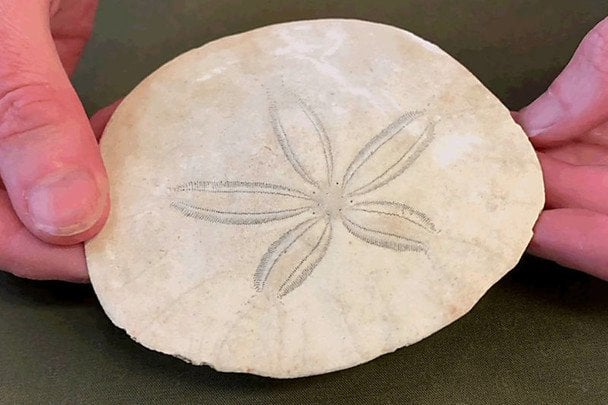
The sand dollar found on the beaches is not a mollusk shell but a hard exoskeleton (shell) of a flat sea urchin, with a diameter of 5–10 cm and a thickness of up to 1 cm. Its shape resembles a large coin.
On the upper part of the sand dollar, you can see a pattern resembling petals or a five-pointed star, which are traces of the breathing (ambulacral) system. A living sand dollar has a dark, almost black color and is covered with numerous velvety appendages that resemble hair.
These appendages are used to capture plankton and small food, which is delivered to the mouth located underneath. The process of chewing food takes up to 15 minutes, and complete digestion lasts up to two days.
Life in the Sand and Regeneration
This species is found along the coast from Alaska to California and usually lives on sandy bottoms at depths of up to 10 meters. Sand dollars can bury themselves in the sand to a depth of up to 15 cm. They are threatened by fish, sea otters, and starfish, but many die from old age (living 6–10 years) or during strong storms.
Sand dollars are capable of regeneration. New cells grow on damaged areas chaotically. This has attracted the attention of scientists who study these animals in search of new approaches to cancer treatment.
Where to Find "Happy Dollars"
Although finding a whole "happy dollar" is considered lucky, there are places where the probability is particularly high:
- Centennial Beach (Tsawwassen Peninsula): especially during strong low tides.
- White Rock: along the muddy bottom closer to the US border during low tide.
- Parksville Beaches on Vancouver Island.
- Pacific Rim National Park Beaches: note that collecting shells here is prohibited.
How to Identify a Living Sand Dollar and Why You Shouldn't Take It from the Beach
The exoskeleton of a sand dollar, resembling a silver coin, is often found on the shore. However, before collecting the find, it is important to be able to distinguish a living animal from a dead shell.
A living specimen has a dark shade – ranging from brown, red, or purple to dark gray. The silvery-white color of the exoskeleton appears only after death when the sun bleaches it.
When touched, a living sand dollar is velvety. Its surface is covered with tiny bristles (spines). If the bristles move, the animal is alive. However, care should be taken, as the spines can cause harm.
Important: a dead sand dollar will be smoother and without bristles, as they fall off over time.
Sand dollars are not poisonous and are safe for humans, regardless of whether they are alive or dead. Living specimens should be carefully returned to the water and left undisturbed.
In many places, it is illegal to collect living sand dollars for drying and use as decorations. For ethical reasons, only empty dead shells should be taken.
Let us remind you that in South America, there lives an insect that surpasses all imagination about the usual size of ants. It is Dinoponera – the largest species of ants on the planet, with worker individuals growing up to 4 centimeters. These giants stand out not only for their size but also for their unusual social organization.
It has also been reported that sharp environmental changes on Easter Island (Rapa Nui) are often regarded as a typical example of environmental change, but recent research seeks to determine the role of Polynesian rats in deforestation.
Read also
- Buses from Ukraine to Poland Suspended for 18 Months Due to Repairs at Shehyni-Medyka Border Crossing
- Suitcase delivery to parcel lockers across 8 EU countries launched by InPost – pricing revealed
- Bus Service to Poland via Shehyni Checkpoint to Halt for 18 Months Starting June 15, 2026
- Over 10 Odesa Beach Zones Certified and Ready for Summer Season
- Anticipating Summer Ticket Surge, Ukrainian Railways Shares Booking Tips
- Europe's Airports Face Six-Hour Queues: IATA Warns of New Crisis