Paleolithic Diet: Why Meat Was Not the Main Food of Our Ancestors.

According to Vox: In far-right circles, a paranoia has emerged around prophecy. Many believe that globalist elites are attempting to replace meat with insects. These ideas are actively spread by provocateurs like Tucker Carlson, Mike Cernovich, and Jordan Peterson, and are also discussed on social media.
Such beliefs have become part of the slogans of right-wing political parties around the world, from the Conservative Party of Canada to the League in Italy and the Law and Justice Party in Poland. Florida Governor Ron DeSantis mentioned the use of insects when banning the production and sale of cultivated meat in his state.
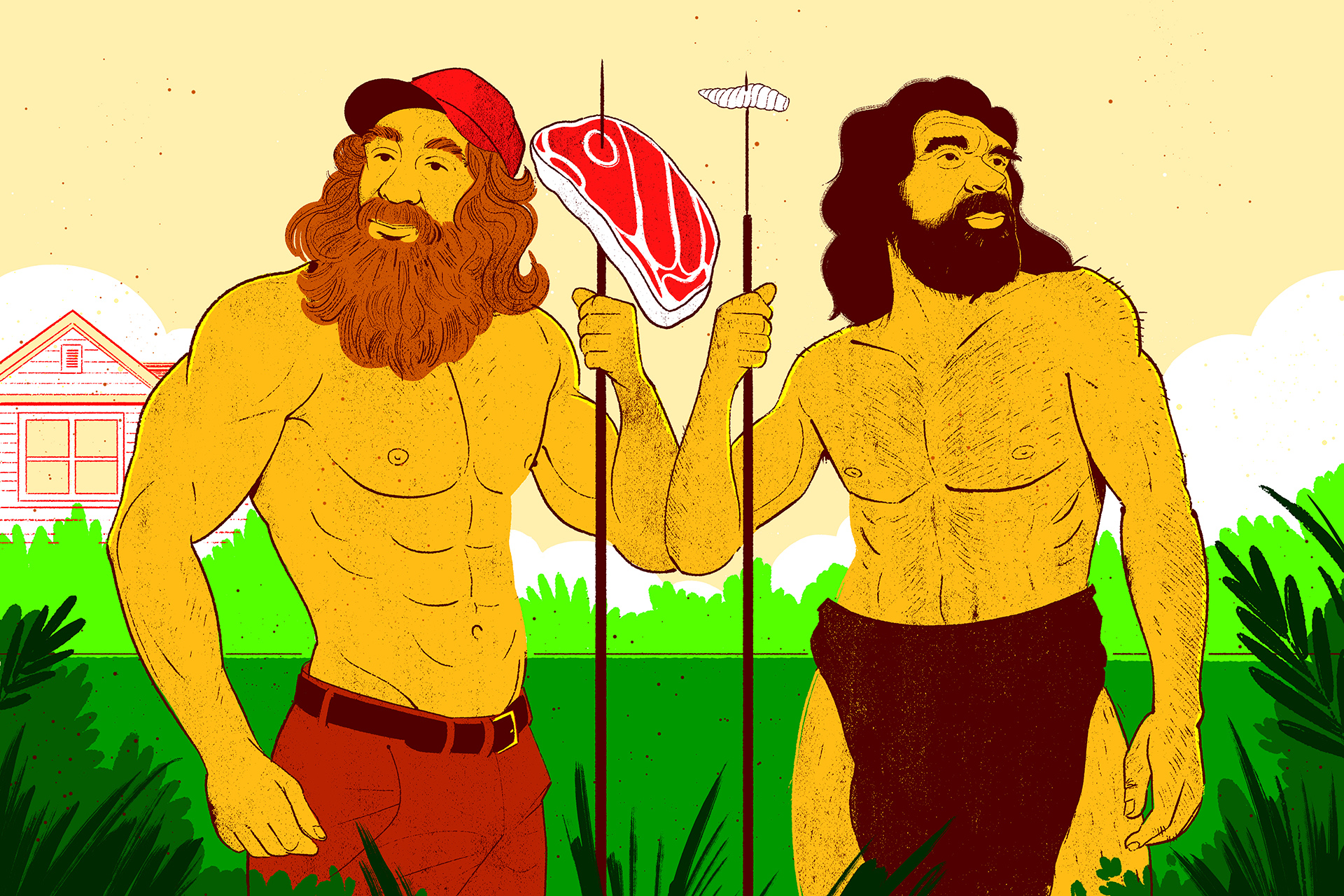
These assertions often accompany popular diets rich in meat and protein, which are gaining traction among so-called manosphere followers and among the right. They believe that such diets bring people back to a Paleolithic past, when ancestors lived solely on freshly hunted game. Jordan Peterson, in particular, actively promotes a keto diet consisting only of meat, comparing it to the diet of hunter-gatherers and criticizing modern diets, which he believes are too high in carbohydrates.
“Perhaps humanity must always remain in hunting mode,”he noted in 2022.
However, our hunter-gatherer ancestors had a much more varied diet, consuming whatever they could find depending on their location and resources. While meat was part of their diet, there were no guarantees of success during hunts, and options for preserving meat were limited. A recent article in Science Advances proposed an interesting theory: decomposed meat might have attracted flies that laid eggs, from which larvae emerged — another source of protein for early humans.
Ironically, part of the Paleolithic diet likely included insects.
Currently, contemporary studies on humans not only concern where our ancestors obtained animal protein but also how much they consumed. In the book The Meat Question, anthropologist Josh Berson writes:
“On the contrary, it is ‘modern’ urban populations, especially in the USA, that demonstrate specialization in animal consumption — not hunter-gatherers, who are often held up as models for meat consumption strategies.”
Those who believe we have fallen from prehistoric carnivorous übermen to plant-based untermen misunderstand history. Only with the advent of modern industrial agriculture did meat become so accessible that Americans could consume it three times a day.
Myths about Nutrition
Myths about how we once ate and how we should probably eat again have become politically significant more than ever. The image of the prehistoric hunter prevails over modern 'gastro-politics', reflecting broad social and political anxieties concerning food. The 'Make America Healthy Again' movement is supported by the growing popularity of meat-based diets; calls for increased meat consumption in federal dietary guidelines have become more frequent. All this is tied to the romanticization of 'natural' pre-industrial produce and distrust of 'industrial' and 'ultra-processed' foods.
But this is no longer just a right-wing phenomenon. The use of prehistoric people as dietary models is close to mainstream narratives about ancestral diets. For example, writer Michael Pollan urged:
“Eat nothing that your great-great-great-grandmother would not recognize as food.”Pollan recently noted that the environmental benefits of meat alternatives may be offset by health and safety concerns associated with numerous ingredients.
This attachment to tradition may lead to the so-called 'food bow' theory: in his book The Omnivore’s Dilemma, Pollan, a liberal Berkeley professor, idealizes small-scale livestock farming, seeking to counter veganism, “globalists”, and processed foods in a podcast with Jordan Peterson.
Both left and right use myths regarding a romantic past to affirm modern identity, politics, and eating habits, diverting attention from important debates about what our nutrition should entail. Among the numerous problems of the modern food system, a lack of meat is not romantic. Studies show the necessity of significantly reducing meat consumption, but to solve this issue, we must first abandon the myths rooted in poor history.
What Was the Prehistoric Diet?
When writing an article for Scientific American in 2017, renowned paleontologist Peter Ungar questioned the concept of the paleo diet.
“What was the ancestral human diet? The question itself makes no sense,”he wrote. The most significant feature of the human diet is its ability to adapt over time and space. Our ancestors consumed what was available, depending on the quantity and environmental conditions. This could include both meat and fat, as well as roots, tubers, and fruit. Scientists today cannot define a single “Paleolithic” diet.
While the image of Paleolithic eating evokes notions of 'hyper-carnivorousness', humans are not natural carnivores, like large cats. We are omnivores, capable of getting nutrients from both plants and animals. The question of meat's relation to human evolution, how much was consumed, and how it was obtained remains an active topic of discussion among scientists. This can vary based on population, time period, and ecology — from very little to significant.
What was the ancestral human diet? The question itself makes no sense.
PETER UNGAR
Reconstructing ancient dietary patterns based on rare fossils is incredibly complicated. Often, it requires literally sifting through the garbage of ancient peoples. Animal bones, along with remnants of tools, can confirm that animals were indeed consumed, though it is difficult to determine the frequency and quantity. Modern discussions of Paleolithic diets emphasize meat from a few species of animals, but our ancestors were omnivorous, consuming many species, many of which are now extinct. Archaeological evidence suggests, for instance, that rats may have been part of the diet.
Genomic and proteomic studies may shed light on ancient diets, and the chemical composition of human bones provides additional evidence. For example, a high content of stable nitrogen isotopes in fossilized bone tissue may indicate the consumption of carrion, but science is continually progressing, offering new explanations, and a recent hypothesis proposes that plants — and now, larvae — may have been sources of that nitrogen content. The latter thought, contained in the Science Advances article, has its roots in the theory that meat, as a limited resource, could be stored even in a state of decay for consumption, as well as for the further propagation of larvae as a source of protein.
Perhaps all these considerations are partially justified. Many theories regarding ancestral diets are also supported by data on contemporary hunter-gatherers. Ungar, for instance, compares the predominantly meat diet of the Tikigaqmiut people in Alaska to the varied diets of the San people from the Kalahari. The authors of the Science Advances article corroborate their archaeological findings with historical evidence from 19th century Arctic and sub-Arctic societies that consumed larvae living in preserved animal carcasses. Their conclusion is that early human populations were not hyper-carnivorous but rather omnivorous opportunists.
The closer we get to modernity, the more we know about the diets of our ancestors. Here, too, historical data do not support the notion of constant meatiness. The domestication of animals, which began to appear in archaeological findings about 12,000 years ago, likely reduced the role of meat in the diet: domesticated animals over thousands of years became more valuable alive than dead — as a source of milk, wool, labor, and fertilizer.
In medieval Europe, pig processing was a seasonal ritual, often associated with special events. In Imperial China, pigs symbolized prosperity; in South Asia, the consumption of beef was prohibited, while cows provided milk and fertilizer. Meat was not always consumed — in many cases, the role of meat products was low by modern standards until recently.
And it was only in the early 20th century that agriculture began to industrialize. The implementation of conveyor systems in meat factories enabled economies of scale and standardized processing of meat. Selective breeding methods significantly increased livestock productivity. As historian William Cronon has demonstrated, these achievements, combined with new technologies such as refrigerated cars and canning, quickly turned meat into an everyday commodity. With the development of cultural agriculture, animal feed became profitable, allowing for the creation of factory farms where pigs and chickens are raised in specialized complexes until slaughter.
These changes have redefined humanity's relationship with meat. Throughout the 20th century, the entire structure of agricultural production changed to feed, breed, and slaughter animals on even larger scales. For instance, in 1909, more than 150 million chickens were sold for slaughter in the USA. In 1949, this figure rose to about 600 million. By 2024, it will reach 9.5 billion. Over the past half-century, meat production in the USA has nearly tripled, while global production has increased fivefold, transforming our food system.
Modern humans, like our Paleolithic ancestors, adapt their eating habits to their environment. Surrounded by increasingly affordable meat, we consume more of it.
Can We Seriously Consider Nutrition Issues?
Modern diets are fraught with concerns, and there are good reasons for this. Our world and food system face numerous issues, from contributing to global climate change to the potential impact of certain additives on health.
These problems are real, but fears based on exaggerations, clichés, and nostalgia for the past do not offer a clear vision for how to address them. Instead, simplified solutions are proposed, such as an absolute rejection of modernity. Ironically, hostility toward agribusinesses and regulatory systems, such as carnivore advocates, raw milk enthusiasts, or frugal consumers, may actually increase the number of dangerous products in our food, as was the case in the 19th century before the creation of the FDA and widespread food preservation technologies.
It is important to note that the modern food system is a significant achievement. Phenomena of malnutrition, such as pellagra and rickets, have been overcome in the past, just as have risks of consuming contaminated, toxic, spoiled, or counterfeit products. Only because food is more accessible, safer, and higher quality than ever in human history can we focus on chronic issues, such as obesity and diabetes.
Addressing these issues requires embracing modernity, rather than rejecting negative reports. It demands genuine engagement with the complexities of the food system and an awareness of several unshakeable truths, such as that it is meat, not food in general, that causes most harm associated with the dietary system. However, an early return to a 'safer' past can serve as both an escapist fantasy and a convenient excuse for poor dietary choices.
In our imaginary past, meat consumption becomes a powerful political symbol that connects us to a tribe. And food turns into a stage for showcasing politics and identity. For gourmets who disdain 'industrial food', a return to small farms and the consumption of 'better' organic meat may signal a commitment to personal health and ecological justice — although this is not always supported by scientific data. On the right flank, meat consumption becomes part of a certain political narrative, embodying masculinity in opposition to modernity, liberalism, and other values.
Yet, in reality, meat-rich diets reflect the status quo and depend on the modern food system, global exchanges, logistical factors, transnational companies, and biotechnologies. Closing factory farms and industrial feedlots would mean the extinction of 99% of chickens, 98% of pork, and 75% of beef in the USA, making mass meat consumption impossible.
As is often the case with myths, those regarding ancestral diets reflect more the anxieties and identities of their creators than actual pasts or even real modernity.
Paradoxically, proponents of prehistoric diets are inspired by the comforts and technologies of the modern world. People did not have the opportunity to select meat for three meals a day as easily as today, without dirtying their hands. The myth of the trans-historical significance of meat obscures the reality that the proportion of meat in modern diets is a historical spike, linked to a food system that focuses on a surplus of meat rather than instinctual needs.
Myths about Paleolithic, ancestral, and great-great-grandmother diets are often more testaments to the anxieties and identities of their advocates than to reality. The image of the primitive hunter is increasingly less accurate according to archaeological and ethnographic data; it reflects modern misconceptions about human evolution mixed with popular culture rather than scientific research.
History teaches us that there is no single way people consumed in the past, nor any defined path we must follow in our diet. Diets form in response to the modern world. Hence, the question is not about what our ancestors ate — whether to eat meat, berries, or larvae — but what rational decisions we can make for our future. This includes questions about why meat is so cheap and accessible, and whether it should remain so. Answers lie in science, public health, and political economy, not in myths. Consuming carrion is, at best, a false trail, and at worst — red meat for reactionary politics.
Read also
- Three Ukrainians Without Documents Rescued from Occupied Territories Under Bring Kids Back UA Initiative
- Ukraine’s first underground kindergarten opens in Kharkiv, accommodating 260 children
- Ukraine's ports crippled by Russian strikes: 28 vessels hit, 21 killed
- 24 Children Rescued from Occupied Territories by Save Ukraine, Including Injured 13-Year-Old Anhelina
- Woman Faces Up to 7.5 Years in Prison After Attacking Children for Speaking Ukrainian in Poland
- One of the Most Recognizable Voices on Ukrainian Radio, Journalist Oleksandr, Has Passed Away