The U.S. Supreme Court Will Hear a Case on Transgender Athletes' Rights: What It Means.

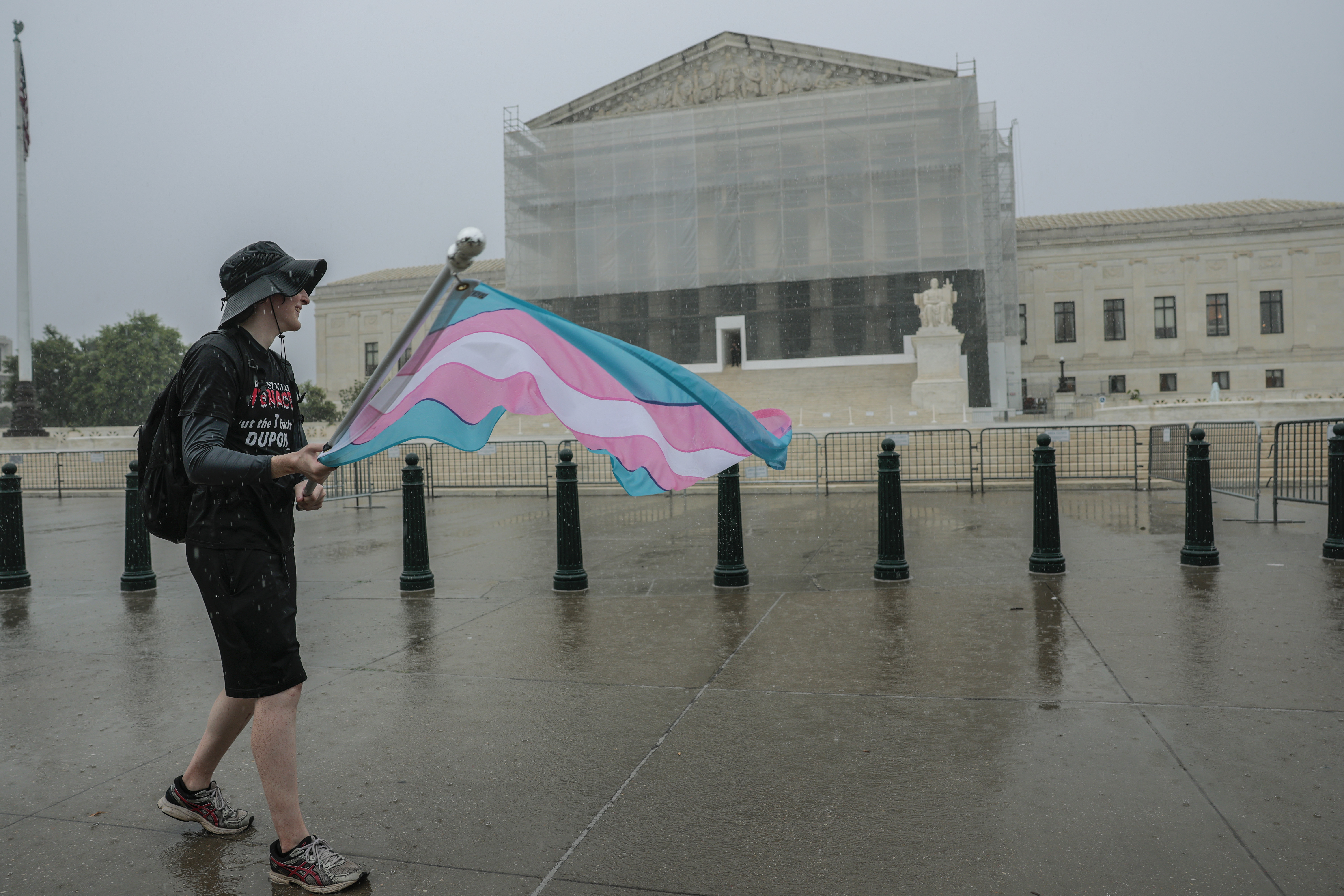
According to Vox: The issue of transgender athletes' rights in school sports has always been one of the most challenging legal battles for advocates of transgender rights.
Supreme Court precedents regarding transgender rights have proven particularly unfavorable to those challenging laws that prohibit transgender women from participating in women’s sports teams. The political aspect of this issue complicates matters for transgender individuals, as the justices of the Supreme Court predominantly hold Republican views, and last year they voted to ban transgender teens from receiving medical care that affirms their gender identity.
Thus, it is likely that most justices will rule in the cases Little v. Hecox or West Virginia v. B.P.J. that states can prohibit transgender women from playing on women's teams at the middle school or college level. Both cases will come before the court, although there is a possibility that the case Hecox will be dismissed, as the plaintiff claims that the situation is now moot.
Key Aspects
- The question of transgender women’s participation in school or college sports has remained one of the most complex legal issues for advocates of transgender rights.
- In the case Bostock v. Clayton County, the Supreme Court ruled that the employment discrimination law prohibiting discrimination 'on the basis of sex' extends to transgender employees.
- However, sex discrimination in sports remains permissible, as teams typically have sex-based restrictions, making the Bostock precedent inapplicable here.
To understand the challenges faced by attorneys for transgender athletes in the cases Hecox and B.P.J., it is essential to examine the ruling in the case Bostock v. Clayton County (2020) – the only significant victory for transgender Americans. The court ruled that federal law prohibiting employment discrimination on the basis of 'sex' protects LGBTQ workers.
Although Bostock acknowledged that the term 'sex' refers to 'biological differences between men and women', it concluded that 'it is impossible to discriminate against a person for being homosexual or transgender without discriminating against that individual based on sex.'
However, this logic does not apply to sports, as the law allows for the creation of sex-based sports teams. If an agency attempts to divide its employees into male and female 'teams', it would be illegal. Nevertheless, schools can, and typically are required to, have separate sports teams for men and women.
Therefore, transgender plaintiffs must prove that they are protected from discrimination because of their transgender identity, not merely because they are men or women. Although the Supreme Court has ruled that ordinary sex discrimination by the government is generally prohibited by the Constitution, it has never recognized transgender Americans as protected solely because of their transgender identity.
In the meantime, some current justices have already expressed the view that transgender individuals do not have constitutional protection. Justice Amy Coney Barrett wrote a separate opinion in the case United States v. Skremetti (2025), stating that it is not the case. Another signal for transgender athletes came when Justice Brett Kavanaugh raised concerns during oral arguments in the case Skremetti that providing transgender women with heightened constitutional protection could undermine fairness and safety issues for some female athletes.
Realistically, transgender athletes may face tough times at the Supreme Court.
What About Hecox and B.P.J.?
The lawsuits in the cases Hecox and B.P.J. are quite moderate. The rulings do not require that all transgender athletes be allowed to participate in women’s sports teams but only a specific group that they believe does not have a competitive advantage.
The plaintiff in B.P.J., whose identity is disclosed only through initials due to her young age, is a high school track athlete. She claims that she 'transitioned at an early age' and 'received treatment to delay puberty and estrogen that affirms gender', thus has never undergone male puberty. The plaintiff in Hecox is Lindsay Hecox, a former student-athlete who receives treatment that lowers testosterone and maintains estrogen, asserting that 'she has testosterone levels typical of cisgender women' (Hecox is also a college student who is currently not playing for any team and states that she has no intention of playing in college, hence claiming that her case is moot).
Neither plaintiff claims that all transgender women should have the right to play in middle school or college sports. Rather, they seek a court ruling that pertains to transgender women with testosterone levels resembling those of cisgender women. Their attorneys argue that this subgroup of transgender women 'does not have a sports advantage' over cis women.
The state of Idaho, which is the defendant in Hecox, presents a significant amount of arguments in its brief that question this factual claim. They rely mainly on the testimony of Gregory Brown, a professor of exercise science, whose professional website describes him as 'a scientific advisor for Turning Point USA'. Meanwhile, the plaintiffs rely on the testimony of Professor Joshua Safer, an endocrinologist, who told the court that 'there is a medical consensus that testosterone difference is a primary known factor influencing differences in athletic performance between elite male and female athletes.'
For the sake of fairness, one of the plaintiffs’ main arguments before the Supreme Court is that this is not the place to resolve a dispute between professors. The courts in Hecox and B.P.J. found Safer’s testimony more persuasive than Brown’s. And appellate courts, including the Supreme Court, typically do not overturn fact-finding conclusions of the lower court unless they are 'clearly erroneous.'
However, this Supreme Court is unlikely to favor lower courts based solely on civil procedure rules. In the case Kennedy v. Bremerton School District (2022), which involved a public school coach who included prayers and other Christian rituals during practices, the Republican majority of the court created an artificial set of facts to justify a ruling in favor of that coach – even defending those false facts when Justice Sonia Sotomayor presented photographic evidence that Republican judges were not telling the truth. In cases involving medical disputes, Republican judges often assert that state legislatures have wide latitude if there is 'medical uncertainty.'
And even if the Supreme Court acknowledges that the lower court’s conclusion that Safer has a more accurate view of how testosterone impacts athletic performance than Brown, the outcome of this battle of professors matters only if the attorneys can convince a majority of justices that transgender people have heightened protection under the Constitution.
Summary of Heightened Scrutiny
In general, governments can discriminate. They can discriminate against unqualified candidates and favor high-qualified ones when deciding whom to hire. They can discriminate against wealthy individuals and favor the poor when determining who receives welfare. And they can discriminate against criminals and favor law-abiding citizens when deciding whom to imprison.
Most laws make certain distinctions between people to whom they apply and those who do not fall under their scope. The Constitution generally allows for such discrimination, even when there is scientific evidence that a particular law discriminates for unreliable reasons.
However, there are forms of discrimination that are usually not allowed. Laws that discriminate based on race, sex, or religion are subject to 'heightened' scrutiny under the Constitution. The specifics of how this scrutiny functions often depend on the type of discrimination – the Constitution places race discrimination under more scrutiny than sex discrimination, yet most laws subject to heightened scrutiny fail.
The Supreme Court ruled in United States v. Virginia (1996) that 'the party seeking to validate government action based on sex must demonstrate an 'exceedingly persuasive justification' for such classification.'
So, how does the Court determine which forms of discrimination are allowed and which are subject to constitutional scrutiny? The main question according to previous rulings is whether a particular group has historically been subjected to discrimination that 'has no relation to ability to perform or contribute to society.'
The Court also sometimes considers other factors: whether a group shows 'obvious, immutable, or distinguishing characteristics that define them as a discrete group,' or whether the group is politically powerless. However, these factors are less important. Discrimination based on religious identity is constitutionally suspect, even if people can change their religion. Women and people of color have not lost their constitutional protection even if they have gained political power compared to women and racial minorities in the past.
Advocates representing the plaintiffs in Hecox and B.P.J. present compelling arguments that discrimination based on gender identity should be subject to heightened scrutiny. In their brief, they cite examples of historical laws aimed against transgender individuals. More than two dozen cities in the U.S., including large cities like Chicago, previously banned 'cross-dressing'. Other laws targeted bars serving 'female impersonators.' Advocates also argue that the United States effectively banned transgender individuals from immigrating.
Gender identity has little to do with an individual's ability to contribute to society. As the plaintiffs’ lawyers point out, 'being transgender does not diminish one’s ability to be a lawyer, engineer, farmer, or doctor.' In U.S. history, only one openly transgender person served in Congress – and did not even complete the term in office.
Will this be enough for the Supreme Court? Most likely, no. Justice Barrett, for example, in her concurrence with Skrmetti, noted that 'no new constitutionally protected classes have been recognized for more than four decades.' Court cases regarding gay rights, for instance, have seemed to actively avoid the question of discrimination based on sexual orientation even when finding other reasons to rule in their favor. Therefore, a decision to add transgender individuals to protected groups would be an extremely unusual move by the Supreme Court.
Even if the Court acknowledges that transgender individuals have that protection, the plaintiffs in Hecox and B.P.J. still must overcome another barrier.
Courts Sometimes Uphold Laws Subject to Heightened Scrutiny
Let’s suppose the attorneys representing Hecox and B.P. persuade a majority of justices that discrimination against transgender individuals is as odious as discrimination against women and that the laws discriminating based on gender identity should be subject to heightened scrutiny. Most laws under this scrutiny fail, but not all of them.
The Court in Virginia noted that laws discriminating on the basis of sex are permissible if they serve 'important government objectives' and 'the discriminatory means employed bear a substantial relationship to the achievement of those objectives.'
For example, one law that discriminates on the basis of sex but was allowed to remain in effect is the law separating men and women on different teams in middle or high school. Because highly athletic men usually outperform highly athletic women in sports, women’s teams are necessary to ensure opportunities for women to play. If there were only teams for women, most women would be excluded from sports in middle schools and colleges as they would not be able to compete against men.
Thus, even if Hecox and B.P.J. can convince the Court that transgender women with low testosterone levels do not have a competitive advantage over cisgender women, and even if they can convince the Court that laws discriminating against transgender individuals should be subject to heightened scrutiny, there remains another barrier to overcome. The law generally allows schools to separate sports teams based on sex at birth, so why should a transgender athlete have a different status than a cis athlete with comparable athletic abilities?
The attorneys for Hecox and B.P. have a compelling argument on this issue. They assert that 'the courts have recognized that sex segregation in sports may pass constitutional muster if men and women still have equal opportunities to compete.' This means that a hypothetical cisgender boy with low testosterone does not face a difficulty since he can still try out for a male team. In contrast, transgender women experiencing gender dysphoria cannot try out for a male team without emotional discomfort.
This argument has persuaded lower courts. As the attorneys for Hecox point out, one court concluded that the claim that transgender women can play on men’s teams is 'analogous to claims that [gay people] do not experience discrimination under legislation banning same-sex marriage since lesbians and gay men can marry someone of the opposite sex' – an argument that the Supreme Court rejected in Obergefell v. Hodges (2015).
However, even if this argument persuades lower courts, it is unclear whether it will convince the Supreme Court. Three current justices dissented in the case Obergefell. Two other justices, Kavanaugh and Barrett, have made it clear that they do not support transgender women seeking to participate in school sports. Together, that makes five votes – a majority on the Supreme Court.
Thus, supporters of transgender inclusion in school sports face enormous challenges at the Supreme Court. Many current members of the Court have already hinted at rejecting the arguments for transgender individuals in the cases Hecox and B.P.J.. Even if these plaintiffs were before a more sympathetic composition of justices, the current legal doctrine does not encourage transgender people in areas where the Constitution allows the state to treat men and women differently.
Read also
- Three Ukrainians Without Documents Rescued from Occupied Territories Under Bring Kids Back UA Initiative
- Ukraine’s first underground kindergarten opens in Kharkiv, accommodating 260 children
- Ukraine's ports crippled by Russian strikes: 28 vessels hit, 21 killed
- 24 Children Rescued from Occupied Territories by Save Ukraine, Including Injured 13-Year-Old Anhelina
- Woman Faces Up to 7.5 Years in Prison After Attacking Children for Speaking Ukrainian in Poland
- One of the Most Recognizable Voices on Ukrainian Radio, Journalist Oleksandr, Has Passed Away